You finally organized the kitchen drawers.
You cleared the bedroom floor, sorted the closet, straightened the bathroom, and put everything back where it belongs.
For a few days, your home feels completely different.
Then the mail starts collecting on the counter. Shoes appear by the door. Clean laundry sits in a basket. The kitchen counter slowly becomes a drop zone again. A drawer that was perfectly organized last weekend is suddenly full of random things.
If this sounds familiar, the problem may not be that you are bad at organizing.
Your organization system may simply be too difficult to maintain.
A home that stays organized isn’t necessarily a home where everything is perfectly arranged. It is a home where the systems match the way people actually live.
The goal isn’t to organize your house over and over again.
The goal is to create systems that make it easier to put things away, prevent unnecessary clutter, and reset your home before small messes become big ones.
Here are the most common reasons an organized home gets messy again—and what to do instead.
1. You’re Organizing for How Your Home Looks, Not How You Use It
One of the easiest mistakes to make is creating an organization system that looks beautiful but doesn’t fit your everyday routine.
A row of matching baskets may look great on a shelf. But if everyone in the house naturally drops things on the nearby table, the baskets aren’t solving the actual problem.
The same thing happens with complicated drawer systems, highly specific categories, and storage that requires too many steps.
Instead, watch what happens naturally.
For a few days, notice:
- Where do bags get dropped?
- Where do mail and packages collect?
- Where do clothes end up?
- What keeps sitting on the kitchen counter?
- Which drawer becomes a catch-all?
- What items are repeatedly left out?
Those habits are useful information.
Your clutter is showing you where your home needs a better system.
Try this
Don’t immediately move everything.
First, identify the recurring behavior.
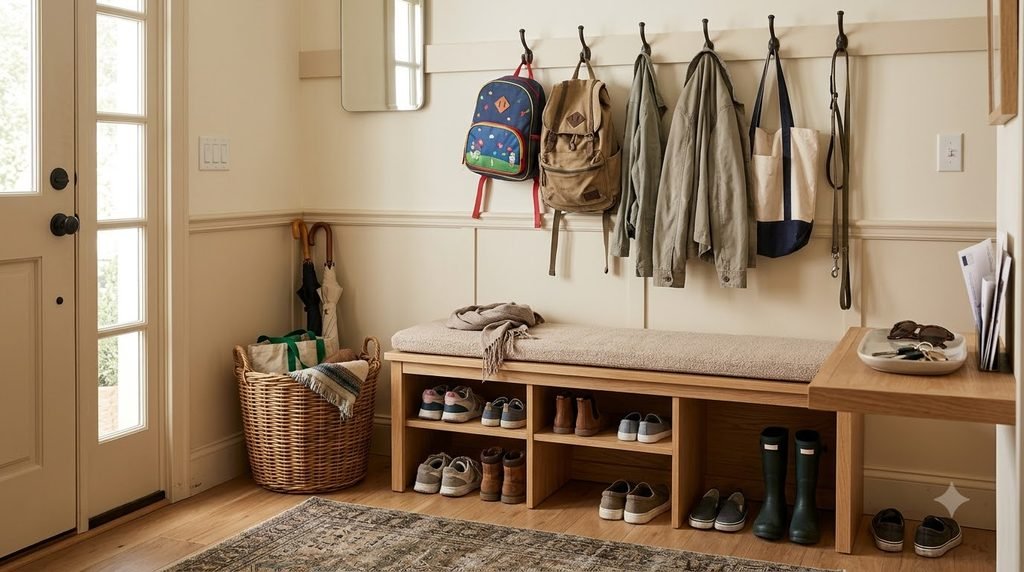
If shoes always end up beside the front door, create shoe storage there.
If chargers always collect beside the sofa, consider a small charging station nearby.
If paperwork lands on the kitchen counter, create a simple paper-management spot close to where you normally sort mail.
The easiest system to maintain is usually the one that works with your existing habits.
2. You’re Putting Things Where They Fit Instead of Where You Use Them
Storage space isn’t useful if it is inconvenient.
Imagine keeping your coffee supplies in a cabinet across the kitchen while your coffee maker sits on the opposite counter.
Technically, everything is organized.
Practically, the system creates extra work every morning.
The same principle applies throughout your home.
Keep frequently used items close to the activity they support.
For example:
- Coffee supplies near the coffee maker
- Everyday cooking tools near the main prep area
- Towels near the bathroom
- Cleaning supplies near the area they are used for
- Keys near the entrance
- Everyday bags near the exit
- Chargers near the places devices are normally used
This doesn’t mean every item needs to be stored in the same room where it is used.
It means convenience should be part of your organization plan.
If putting something away takes several unnecessary steps, it is much more likely to be left out.
3. You’re Buying Organizers Before Solving the Actual Problem
This is one of the biggest traps in home organization.
You see a beautiful drawer organizer.
Then a set of baskets.
Then matching bins.
Then a rotating tray.
Before you know it, you’ve spent money organizing things you may not even need to keep.
An organizer should solve a specific problem.
It shouldn’t be the first step.
Use this order instead:
Remove → Group → Measure → Assign → Organize
Remove
Take out trash, broken items, duplicates, and things that belong somewhere else.
Group
Put similar items together so you can see what you’re actually storing.
Measure
Understand the available space before buying anything.
Assign
Decide where each category should live.
Organize
Only now choose containers, dividers, shelves, hooks, or other storage solutions.
This approach can save money and usually creates a much simpler system.
For example, if your junk drawer keeps overflowing, don’t immediately buy a larger organizer. First determine whether the drawer contains items that belong somewhere else.
You can use the JessicaMillers junk drawer organization guide for a more detailed drawer-specific system.
4. Your Storage System Takes Too Much Effort
This is a simple test:
How many steps does it take to put something away?
If the answer is five or six, the system may not last.
Imagine a child’s toy needs to be:
- Sorted by type
- Put into a small container
- Container placed inside a cabinet
- Cabinet door opened
- Lid removed
That’s a lot of friction.
Compare that with:
Pick up toy → place it in open basket.
The second system is much more likely to survive a busy weekday.
This doesn’t mean every item should be thrown into a basket.
It means frequently used categories should have low-friction homes.
If your family is constantly leaving something out, ask whether the storage location is too difficult to use.
Sometimes moving an item six feet can make more difference than buying a $30 organizer.
5. You Have No Landing Place for Incoming Stuff
Your home doesn’t only have the belongings you already own.
New things enter every day.
Think about:
- Packages
- Groceries
- School papers
- Work bags
- Shoes
- Coats
- Receipts
- Chargers
- Returns
- Items brought home from errands
If there isn’t a temporary landing place, these things start occupying whatever surface is available.
The kitchen counter becomes the mail station.
The dining table becomes the package station.
The stairs become the “I’ll take this upstairs later” station.
Instead, create simple landing zones.
For mail
Incoming → Action → File → Recycle
For items that belong upstairs
Use a small basket temporarily rather than leaving individual objects around the house.
For bags and coats
Create a dedicated entryway drop zone.
If your entryway is already becoming a clutter hotspot, see our entryway organization ideas for practical ways to create a more functional drop zone.
The goal isn’t to create more storage everywhere.
It’s to stop everyday incoming items from spreading across the house.
6. Your Surfaces Have Become Permanent Storage
Flat surfaces are powerful clutter magnets.
Kitchen counters.
Dining tables.
Coffee tables.
Dressers.
Nightstands.
Bathroom counters.
Home office desks.
When an item doesn’t have an obvious home, it often ends up on a flat surface.
And once one item appears, more usually follow.
But there is an important distinction:
A useful surface isn’t the same as a cluttered surface.
Your kitchen counter may legitimately hold a coffee maker that you use every morning.
Your desk may need a monitor and notebook.
Your nightstand may need a lamp and phone charger.
The problem begins when surfaces become permanent storage for things that don’t support the activity happening there.
Try a surface rule
Choose one or two high-impact surfaces and protect them from becoming permanent storage.
For example:
Kitchen counter: cooking and food preparation
Dining table: eating and family activities
Desk: work
Nightstand: bedtime essentials
This doesn’t mean every surface must be completely empty.
It means each surface should have a purpose.
7. You Are Keeping Too Much “Just in Case” Stuff
Sometimes the problem isn’t the organization system.
There is simply more stuff than the available storage can comfortably hold.
“Just in case” items are especially difficult.
Maybe you’ll need it someday.
Maybe you’ll repair it.
Maybe someone will use it.
Maybe you’ll need it if you move.
Maybe you’ll need it for a future project.
One or two useful backups aren’t a problem.
But when every category contains multiple “just in case” items, storage disappears quickly.
Before keeping something, ask:
- Have I used this recently?
- Do I know when I would realistically use it?
- Do I already own another one?
- Would replacing it be difficult or expensive?
- Is it worth giving this item permanent storage space?
You don’t need to become a minimalist.
The goal is simply to make sure your storage isn’t being consumed by things you rarely use.
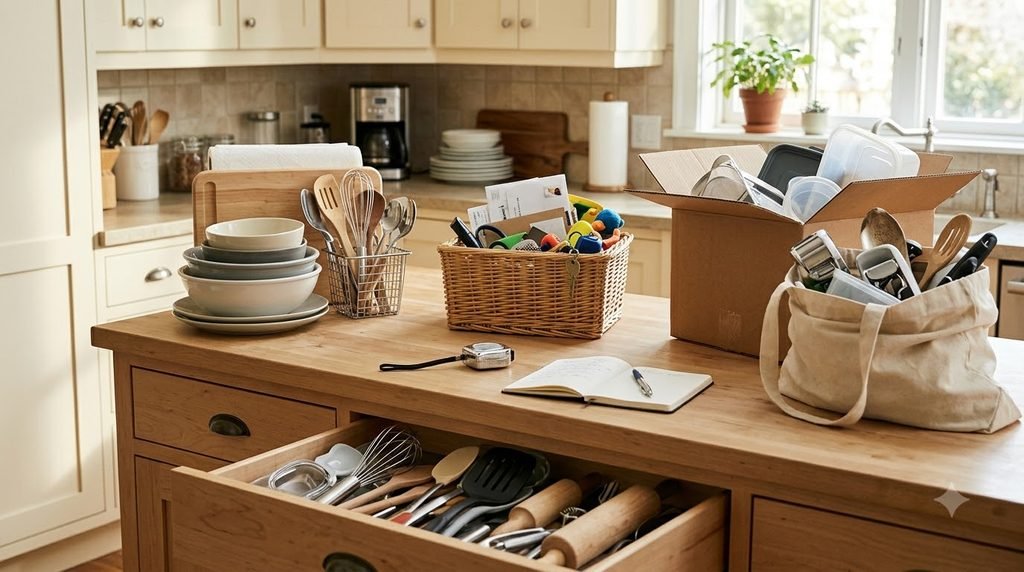
8. Your Home Has No Capacity Limit
This is one of the most important principles for maintaining organization.
Every storage area has a physical limit.
A bathroom drawer can only comfortably hold so many products.
A closet can only hold so many clothes before everything becomes difficult to access.
A pantry shelf can only hold so many food packages.
A junk drawer can only hold so many miscellaneous items before it becomes impossible to find anything.
Instead of trying to make storage hold more and more, establish a practical capacity.
For example:
If your bathroom drawer comfortably holds 20 products, 20 products may be the limit.
If you buy product number 21, something needs to change.
You can:
- Use something up
- Remove something
- Move a less-used item
- Combine duplicates
- Reconsider the category
This is more sustainable than continually adding another container.
Your storage space can actually help you make better decisions.
9. You’re Organizing Rooms Instead of Routines
A room is a physical space.
A routine is what actually happens there.
This distinction can completely change how you organize your home.
Instead of thinking only:
Kitchen
Think:
- Breakfast
- Coffee
- Cooking
- Baking
- Lunch preparation
- Cleanup
Instead of only:
Bedroom
Think:
- Getting dressed
- Preparing for bed
- Charging devices
- Laundry
- Morning routine
Instead of only:
Entryway
Think:
- Coming home
- Leaving home
- Shoes
- Bags
- Keys
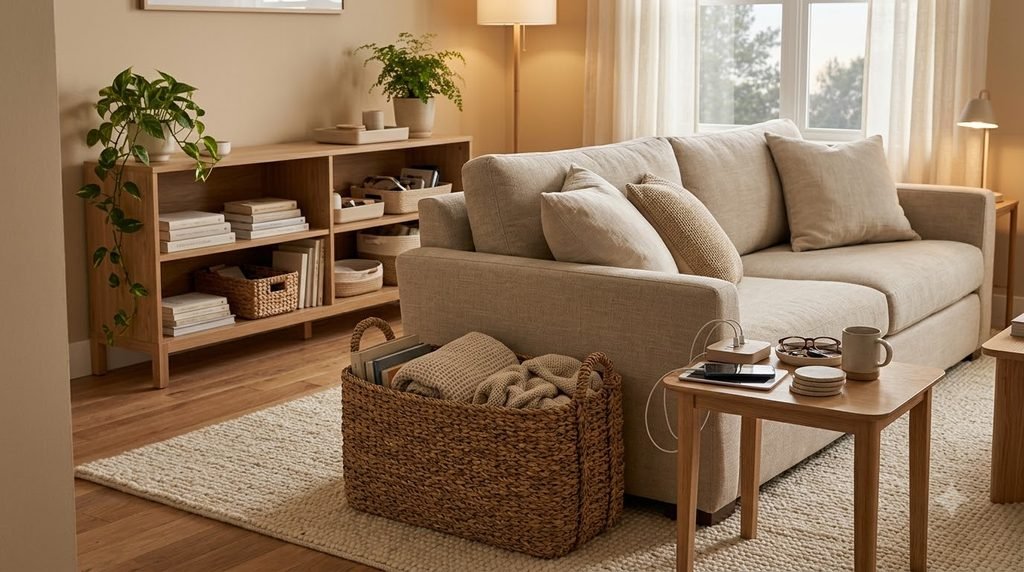
When you organize around routines, the home starts supporting the way you actually move through it.
This is one reason a small change can sometimes work better than a major reorganization.
10. You Haven’t Given Frequently Used Items the Best Storage
Not everything deserves equal access.
A simple rule:
Daily-use items
Keep them easy to reach.
Weekly-use items
Keep them accessible but slightly farther away.
Occasional-use items
Use higher shelves, deeper cabinets, or secondary storage.
Seasonal items
Move them into dedicated seasonal storage when appropriate.
This approach prevents your everyday belongings from competing with things you use only a few times a year.
For example, your favorite everyday clothes shouldn’t have to compete for prime closet space with holiday outfits.
Your everyday bathroom products shouldn’t occupy the easiest-to-reach areas alongside backup toiletries.
Your frequently used kitchen tools should be easier to reach than equipment you use twice a year.
11. Your Whole Family Doesn’t Know the System
An organization system isn’t truly working if only one person understands it.
If you are constantly answering:
“Where does this go?”
the system may be too complicated or unclear.
The best household systems are obvious.
Someone should be able to look at an item and have a reasonable idea where it belongs.
Simple labels can help.
Broad categories can help.
Open baskets can help.
Consistent locations can help.
But don’t create dozens of tiny categories just because they look organized.
A system that everyone understands is usually more valuable than one that looks perfect.
A good test
Ask someone else in your household to put five common items away.
Don’t help them.
If they repeatedly ask where things belong, your system may need to become simpler.
12. You’re Trying to Maintain Too Many Rules
Organization should make life easier.
If maintaining your home requires:
- Perfect folding
- Color-coded categories
- Matching containers
- Constant labeling
- Daily deep cleaning
- Frequent rearranging
the system may be doing too much.
You don’t need a showroom.
You need a home that functions.
A sustainable system should still work when:
- You’re tired
- You’re busy
- You’re running late
- Your family has had a hectic week
- You skip a day
That’s the real test.
If your system only works when you have plenty of time, it isn’t finished yet.
The HOME Test: A Simple Way to Fix an Organization System
When a space keeps becoming messy, use this four-part test.
H — Habit
Does the storage system match what you naturally do?
If everyone drops bags beside the door, maybe that is where the bag storage belongs.
If mail always enters through the kitchen, the mail system should probably be nearby.
O — Ownership
Do you own more than the space can comfortably hold?
If yes, organizing may not be enough.
You may need to reduce, rotate, relocate, or rethink the category.
M — Movement
Is the item stored close enough to where you actually use it?
If you have to walk across the house every time you need something, you’re more likely to leave it out.
E — Effort
How hard is it to put the item away?
If the process is complicated, simplify it.
The HOME Test in one sentence:
A sustainable organization system should match your habits, fit what you own, follow how you move through your home, and require little effort to maintain.
Save this test for the next time an organized space starts falling apart.
The 10-Minute Daily Reset That Prevents Clutter From Taking Over
You don’t need to reorganize your entire house every evening.
A short reset can prevent small problems from becoming weekend projects.

Try this:
Minute 1–2: Collect
Walk through the main living areas and collect things that are obviously out of place.
Minute 3–4: Return
Put those items back into their normal homes.
Minute 5–6: Clear one surface
Choose the kitchen counter, dining table, coffee table, or another high-impact surface.
Minute 7–8: Reset the kitchen
Put away dishes, clear food-related clutter, and return frequently used items.
Minute 9: Reset the entryway
Put away shoes, bags, jackets, and anything that doesn’t belong.
Minute 10: Stop
Don’t start a new organizing project.
Don’t open the junk drawer.
Don’t decide to reorganize the closet.
Just finish the reset.
The goal is consistency, not exhaustion.
If you prefer a larger weekly routine, our Sunday Reset Checklist includes a practical 20-step reset that can be completed in about an hour or broken into smaller sessions.
What to Do When an Organized Space Starts Getting Messy Again
Don’t immediately start over.
Instead, diagnose the problem.
Step 1: Look at what is accumulating
What keeps appearing?
Clothes?
Mail?
Toys?
Chargers?
Kitchen supplies?
Step 2: Ask why
Why isn’t it being put away?
Maybe the storage is too far away.
Maybe the category is too large.
Maybe the storage is full.
Maybe nobody knows where it belongs.
Step 3: Change the system
Move the storage.
Reduce the category.
Create a clearer home.
Simplify the process.
Step 4: Test it for a week
Don’t keep changing the system every day.
Give it enough time to see whether it actually works.
Step 5: Adjust only if necessary
A good organization system doesn’t have to be perfect on day one.
It needs to improve over time.
Start With Your Biggest Recurring Clutter Zone
Don’t try to fix your entire home at once.
Choose the place that creates the most daily frustration.
That might be:
- Kitchen counter
- Entryway
- Bedroom floor
- Bathroom vanity
- Junk drawer
- Closet
- Home office
- Pantry
- Utility closet
Then ask:
What keeps going wrong here?
For example, if your kitchen counter repeatedly becomes cluttered, don’t simply clear it again.
Find out what the counter is being used for.
If it is collecting mail, groceries, appliances, school papers, and household items, you may have several separate problems creating one visible mess.
Solve those individual problems instead of repeatedly cleaning the same surface.
For more practical ideas, see our 10 Simple Home Organization Ideas That Make Everyday Life Easier.
When You Need More Than a Quick Reset
A daily reset is useful for maintenance.
But sometimes a space needs a deeper organization session.
Consider a full reset when:
- You can’t find things easily.
- Storage areas are consistently overfilled.
- Items have no clear categories.
- You have many duplicates.
- You are constantly moving things from one place to another.
- Your current system is difficult to use.
- You have accumulated things you no longer need.
In those cases, start with decluttering and sorting, not shopping.
Then build a new system based on what remains.
For smaller homes, our small space organization ideas can help you make better use of vertical space, doors, corners, furniture, and other overlooked areas.
How to Keep Different Areas Organized
Once you understand the basic principles, apply them to each area of your home.
Bedroom
Keep daily clothing easy to reach, protect clear floor space, and give your nightstand a defined purpose.
Our bedroom organization ideas cover practical ways to use under-bed storage, vertical space, clothing categories, and daily reset habits.
Bathroom
Keep everyday products accessible and move backups and rarely used items into secondary storage.
If your bathroom vanity is constantly becoming crowded, see our guide to organizing a small bathroom vanity without losing counter space.
Entryway
Give shoes, bags, keys, and jackets obvious homes.
Your entryway organization guide can help you create a practical drop zone without filling a small entrance with furniture.
Kitchen
Organize around the routines you actually perform: cooking, breakfast, coffee, baking, and food preparation.
If your counter is constantly covered, start with our guide to organizing a small kitchen counter without losing prep space.
Pantry
Keep frequently used foods visible and accessible, while using less convenient areas for occasional or backup items.
Our pantry organization ideas can help you create simpler categories and improve visibility.
Utility Closet
Group household supplies according to how often and why you use them.
Our utility closet organization guide focuses on categories, access, vertical storage, and avoiding unnecessary containers.
Home Office
Your workspace should support work rather than become general household storage.
Our small home office organization guide focuses on keeping the desktop useful, defining the purpose of the workspace, and using storage without overwhelming a small footprint.
A Simple Weekly Maintenance System
Once your home has workable systems, maintenance can be surprisingly simple.
Daily
Spend about 10 minutes:
- Return misplaced items
- Clear one major surface
- Reset the kitchen
- Reset the entryway
- Put away obvious clutter
Weekly
Spend 20–30 minutes:
- Check clutter hotspots
- Review mail and papers
- Look for overflowing categories
- Reset frequently used storage
- Remove things that have accumulated without a purpose
Monthly
Spend a little longer on:
- One storage category
- One drawer or cabinet
- Seasonal clothing
- Pantry or household backups
- Items that repeatedly don’t have a home
Seasonally
Review:
- Clothing
- Decor
- Outdoor items
- Holiday supplies
- Seasonal equipment
- Guest or entertaining supplies
The goal is to catch problems while they’re still small.
The “One Problem at a Time” Rule
One of the fastest ways to become overwhelmed is trying to fix everything simultaneously.
Instead:
One problem.
One system.
One test period.
For example:
This week → kitchen counter.
Next week → entryway.
Then → bathroom vanity.
Then → bedroom nightstand.
This approach gives you time to learn what works before moving on.
And if one system fails, you only need to fix one system—not your entire house.
Frequently Asked Questions
Why does my house get messy again after I organize it?
Usually because the organization system doesn’t match your habits, the storage is inconvenient, the space is holding more than it can comfortably handle, or there isn’t a simple maintenance routine.
Instead of repeatedly reorganizing, identify what keeps becoming messy and determine why.
How do I keep my house organized every day?
Focus on small resets rather than constant cleaning. Return items to their homes, clear one or two high-impact surfaces, reset the kitchen and entryway, and deal with incoming clutter before it spreads.
A 10-minute daily reset can be easier to maintain than a large weekly organizing project.
Should I buy storage containers before decluttering?
Usually, no.
First remove trash, duplicates, misplaced items, and things you no longer need. Then group what remains and measure your available space.
Only buy storage when you know what problem the product needs to solve.
What is the best way to organize a home?
There isn’t one universal system.
The best system is one that matches your habits, the amount you own, where you use your belongings, and how much effort you can realistically spend maintaining the system.
How do I organize when I have too much stuff?
Start with one category or area rather than the entire home.
Remove obvious trash and duplicates first. Then decide what deserves the limited storage space you have.
If a category consistently exceeds its storage capacity, you may need to reduce it rather than simply adding another container.
How often should I reorganize my home?
You shouldn’t need to completely reorganize your home regularly.
Use short daily or weekly resets for maintenance and reserve deeper organization sessions for areas that have developed a genuine problem.
If the same space repeatedly becomes messy, change the system instead of simply reorganizing it more often.
What if my family won’t put things away?
Start by making the system easier.
Use obvious locations, broad categories, accessible storage, and labels where helpful.
If people consistently ignore a storage location, ask why. The system may be inconvenient rather than the people being unwilling to use it.
A Quick “Is My Organization System Actually Working?” Checklist
Save this checklist and use it whenever a space starts becoming messy again.
The System Check
☐ Do frequently used items have easy-to-reach homes?
☐ Are things stored close to where they’re actually used?
☐ Does every major category have a defined home?
☐ Is the storage easy to access?
☐ Can another person understand the system?
☐ Is the space holding more than it can comfortably handle?
☐ Have I removed unnecessary duplicates?
☐ Am I using containers to solve a problem rather than simply because they look nice?
☐ Can I maintain the system when I’m tired or busy?
☐ Do I have a simple reset routine?
If you answer “no” to several of these questions, don’t buy more organizers yet.
Fix the system first.
Final Thoughts
A home that stays organized isn’t created by one massive weekend of cleaning.
It’s created by small systems that make everyday life easier.
Put things where you naturally use them.
Keep frequently used items easy to reach.
Give incoming items a landing place.
Don’t let surfaces become permanent storage.
Set realistic capacity limits.
Declutter before buying more organizers.
And most importantly, make your systems easy enough to maintain when life gets busy.
When an organized space becomes messy again, don’t assume you failed.
Treat the mess as information.
It may be showing you that something is stored in the wrong place, that you own more than the space can handle, or that the system requires too much effort.
Fix that underlying problem, and organization becomes much easier to maintain.
Your goal isn’t a home that looks perfect every day.
It’s a home that works better every day.
And that’s what sustainable organization is really about.