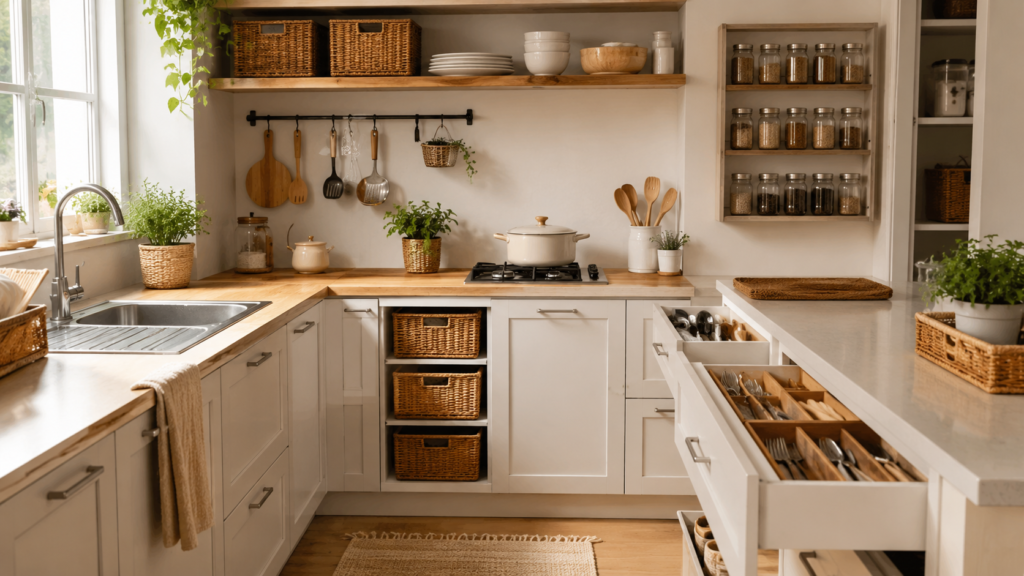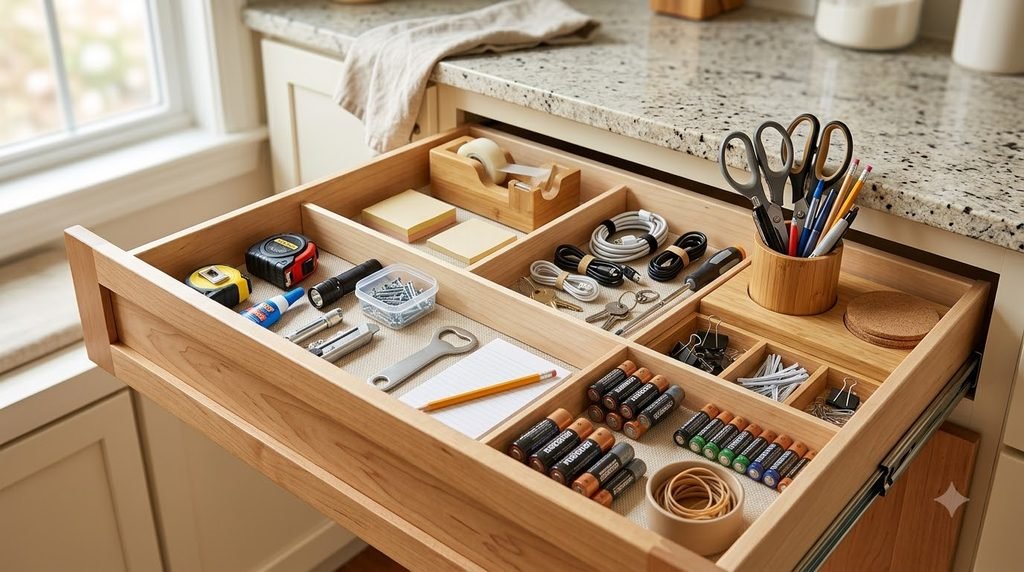
Almost every home has one.
The drawer where batteries, pens, scissors, tape, spare keys, twist ties, small tools, and all those little household items that don’t seem to have another obvious home somehow end up together.
A junk drawer isn’t necessarily a bad thing.
In fact, a well-managed catch-all drawer can keep small everyday items from spreading across kitchen counters, desks, and other surfaces. The problem starts when the drawer has no boundaries or simple system.
Then finding one pair of scissors can turn into a five-minute excavation project.
The goal isn’t to create a perfectly minimalist drawer. It’s to create a useful, defined storage zone where small household items have a place and are easy to find.
And you don’t need dozens of tiny containers to make it happen.
Here are practical junk drawer organization ideas you can use to reset your drawer, make better use of the space, and keep it tidy with minimal maintenance.
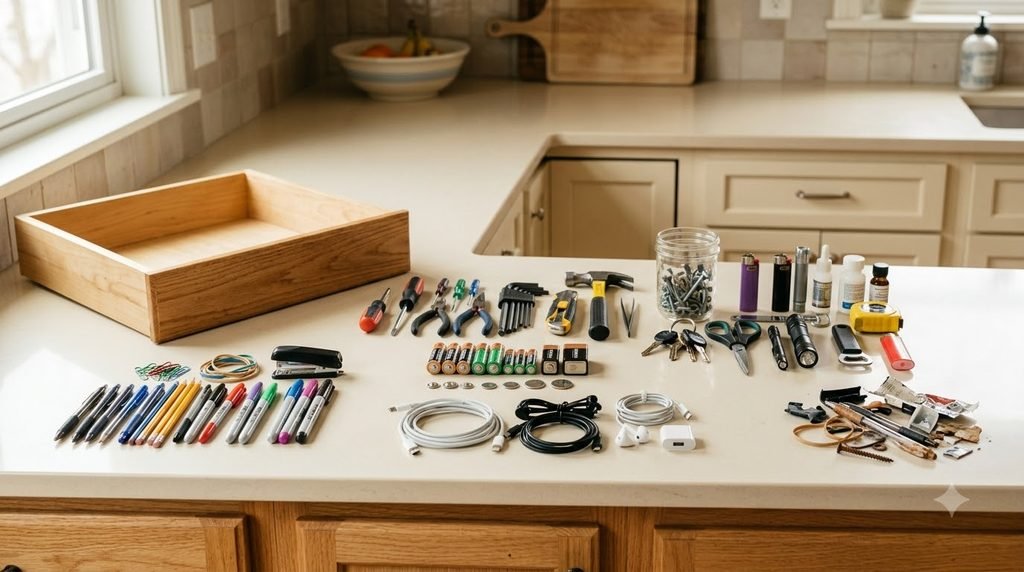
1. Empty the Junk Drawer Completely
Start by taking everything out.
Don’t try to organize around the existing mess. Put every item on a nearby counter or table so you can see exactly what you’re working with.
Once everything is visible, you’ll usually notice that several different categories have been mixed together.
Create rough groups such as:
- Writing supplies
- Small tools
- Batteries
- Cords and electronics
- Fasteners and hardware
- Household odds and ends
- Papers
- Mystery items
Don’t worry about creating perfect categories yet.
The first goal is simply to make everything visible.
Once the drawer is empty, cleaning the inside is also much easier. Wipe away crumbs, dust, or anything else that has collected underneath the contents.
2. Throw Out the Obvious Junk First
Before buying organizers or deciding where everything should go, remove the items that don’t need to be organized at all.
Look for:
- Dried-out pens
- Empty packaging
- Old coupons
- Broken items
- Random scraps of paper
- Duplicate items you clearly don’t need
- Mystery objects with no useful purpose
- Items you haven’t used and have no realistic reason to keep
A lot of junk-drawer problems aren’t really storage problems.
They’re too-much-stuff problems.
You don’t need to throw something away simply because it has been sitting in the drawer for a long time. But if an item has no useful purpose and you can’t realistically see yourself using it, there’s probably no reason to give it valuable drawer space.
This is also a good time to put obvious misplaced items back where they belong.
3. Decide What Actually Belongs in the Drawer
The word “junk” can make it sound like anything goes.
That’s usually what causes the drawer to become overwhelming.
Instead, think of it as a small household utility drawer.
Useful candidates might include:
- Scissors
- Tape
- Pens
- Small screwdrivers
- Measuring tape
- Rubber bands
- Batteries
- Small hooks
- Twist ties
- Spare keys
- Small hardware
- Frequently used household odds and ends
Items that already have a better home should usually go somewhere else.
For example, a large collection of craft supplies belongs with your craft supplies. A full collection of tools belongs in a toolbox or utility area.
The junk drawer should be for small items you actually use, not everything in the house that doesn’t have a home.
4. Use Broad Categories Instead of Dozens of Tiny Ones
Once you’ve removed unnecessary items, group what remains.
Try not to create fifteen tiny categories. A system that is too complicated can become harder to maintain than the original mess.
Five or six broad categories are often enough.
Writing
Pens, pencils, markers, and small writing accessories.
Tools
Small screwdrivers, measuring tape, mini tools, and frequently used hardware.
Fasteners
Rubber bands, twist ties, hooks, and similar small items.
Electronics
Charging adapters, small cables, and compact tech accessories.
Batteries
Batteries and related small accessories.
Miscellaneous
The genuinely useful small items that don’t fit neatly into another category.
The key is to keep miscellaneous limited.
Otherwise, you simply create another junk drawer inside the junk drawer.
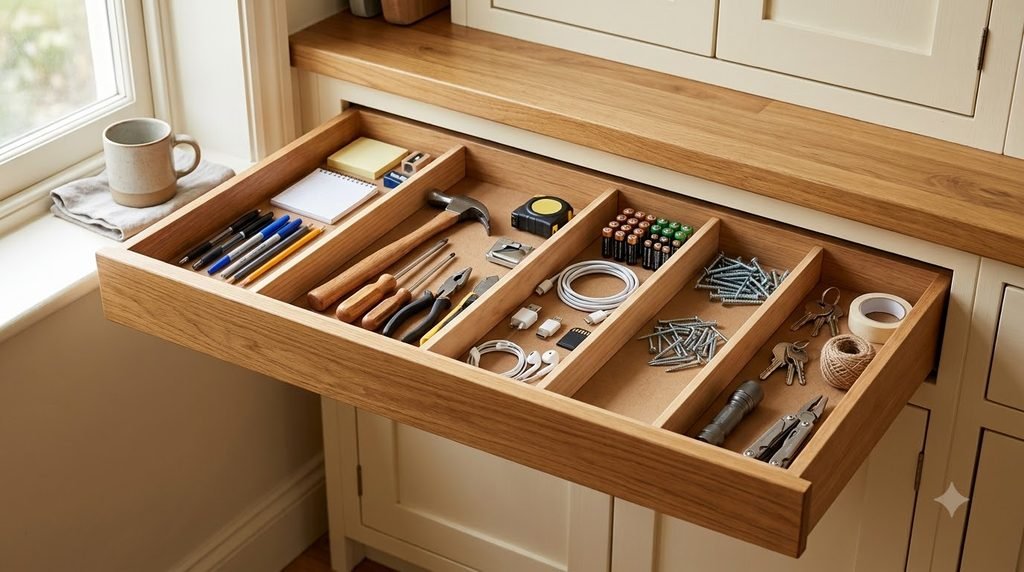
5. Create a Limited Catch-All Section
You don’t need to eliminate the catch-all function completely.
Real homes don’t work like perfectly organized showroom displays. There will always be an occasional small item that needs a temporary place.
Instead of trying to organize every single object into a rigid system, give those items one clearly defined section.
It might hold:
- A spare key
- A small part you need tomorrow
- A temporary household item
- Something you’re still deciding where to store
The important part is giving the catch-all section a boundary.
Catch-all doesn’t mean unlimited.
If that small section becomes full, that’s your signal to sort it before the entire drawer starts spreading into other categories.
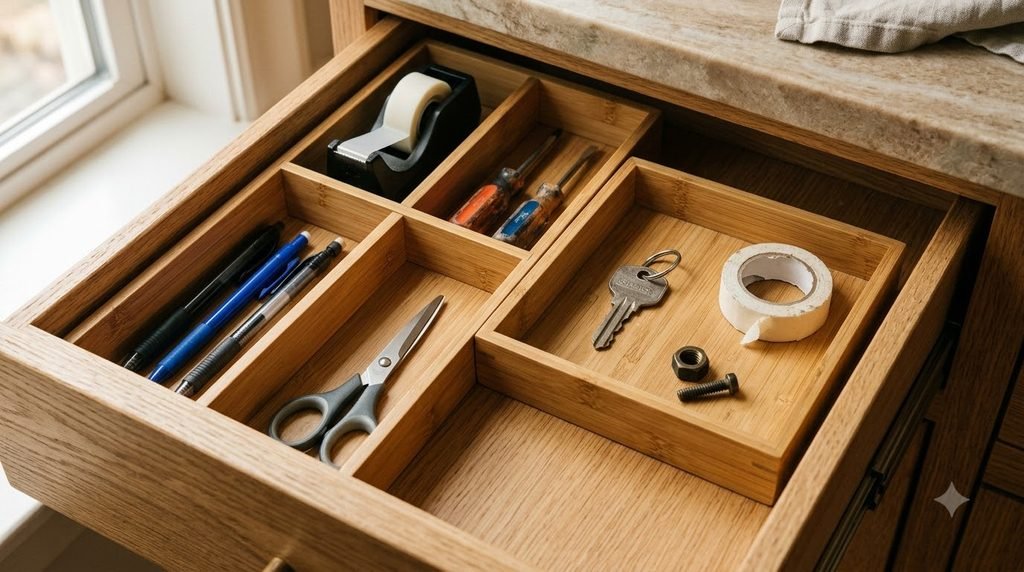
6. Give Small Tools Their Own Section
Small tools are often useful in a junk drawer because they’re convenient for quick household jobs.
Create one compact tool section for things such as:
- Small screwdrivers
- Measuring tape
- Mini wrench
- Allen keys
- Small pliers
- Utility scissors
- Small hardware
Keep frequently used tools toward the front.
If your household already has a proper toolbox, don’t duplicate the entire collection in the drawer. Choose only the small tools you genuinely use for quick everyday tasks.
The goal is convenience, not creating a second toolbox.
7. Give Batteries Their Own Safe Category
Batteries have a habit of migrating around the house.
Some end up in junk drawers, some in cabinets, and others get forgotten in old packaging.
Give them one recognizable location instead.
Keep batteries contained rather than loose throughout the drawer, and avoid mixing loose batteries with metal objects such as coins, paper clips, or other conductive items.
Follow the battery manufacturer’s storage and disposal guidance, especially for damaged or leaking batteries.
The goal is simple:
One recognizable battery zone instead of batteries scattered throughout the drawer.
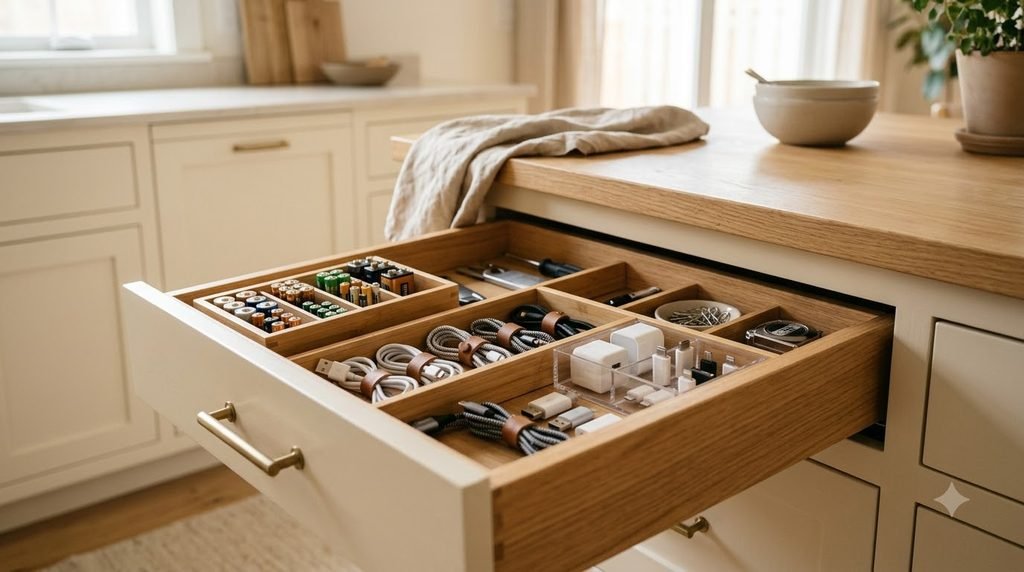
8. Contain Cords and Small Electronics
Cords can quickly turn an organized drawer into a tangled mess.
Before organizing them, identify what you actually use.
Then group similar items together:
Charging Cables
Keep commonly used charging cables together.
Adapters
Create a separate small section for compact adapters.
Small Electronic Accessories
Keep useful tech accessories together rather than letting them spread throughout the drawer.
A small compartment or flexible organizer can help when these items tend to move around.
Avoid creating a container full of unidentified cables.
If you don’t know what a cable belongs to and have no realistic use for it, consider whether it needs to stay.
9. Organize a Small Junk Drawer Differently
A small junk drawer needs a slightly different strategy.
When space is limited, you can’t give every category a large compartment.
Instead:
- Prioritize the items you use most often.
- Use narrow dividers instead of oversized trays.
- Keep categories broad.
- Limit the catch-all section.
- Avoid storing duplicate supplies.
- Keep frequently used items easy to reach.
- Leave enough space to return items without rearranging everything.
For a very small drawer, you may only need three or four categories.
For example:
Section 1: Everyday tools and scissors
Section 2: Pens and tape
Section 3: Small hardware and fasteners
Section 4: Limited miscellaneous items
Don’t force every possible household category into one tiny drawer.
Sometimes the best small-drawer organization idea is simply keeping fewer things in the drawer.
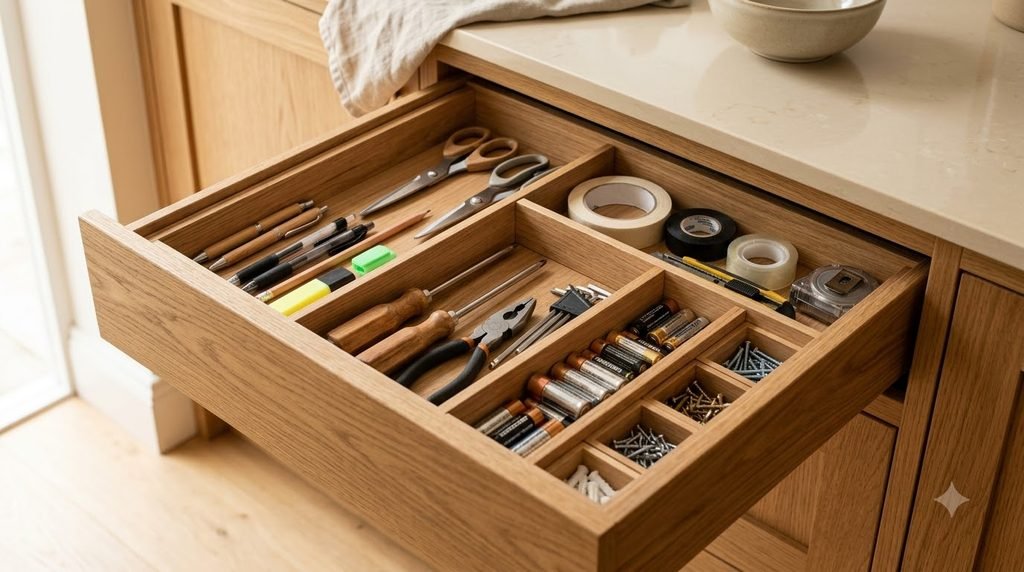
10. Use Adjustable Drawer Dividers When They Actually Help
When They Actually HelpOnce your categories are clear, decide whether you need dividers.
You don’t have to buy an organizer simply because the drawer looks messy.
For many junk drawers, adjustable dividers are useful because you can create sections around the items you actually own.
They can separate:
- Pens
- Tools
- Batteries
- Cords
- Hardware
- Catch-all items
What to Look For in a Junk Drawer Organizer
Choose a system based on your actual drawer.
Look for:
- Adjustable width
- Appropriate drawer depth
- A secure fit
- Compartments that match your categories
- A design that can be changed later
Measure the drawer before buying anything.
An organizer that looks perfect online is not useful if it prevents the drawer from closing or wastes half the available space.
Check the current price on Amazon
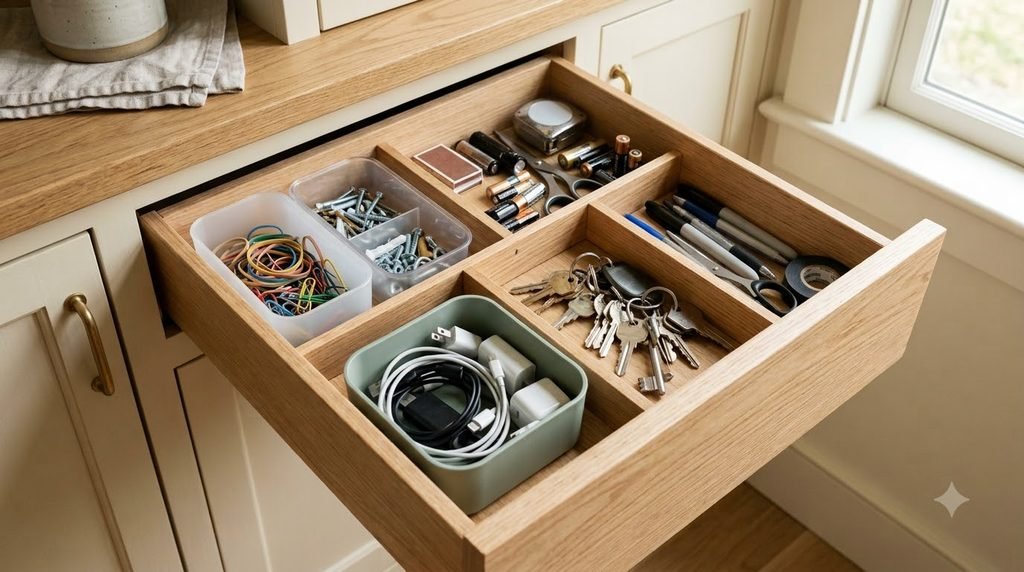
11. Try Small Bins Only Where They Help
It can be tempting to fill the entire drawer with tiny containers.
Don’t.
Containers are useful when they keep a category together. They become less useful when every individual item needs its own box.
You might use one small bin for:
- Rubber bands
- Small hardware
- Charging accessories
- Spare keys
- Loose fasteners
The best organizing system is usually the one that gives each category just enough containment, not the one with the most containers.
12. Keep Everyday Items Toward the Front
Think about how often you use each category.
Frequently used items should be easiest to reach.
For example:
Front: scissors, pens, tape, everyday tools
Middle: batteries, cords, hardware
Back: occasional or backup items
This simple arrangement can make the drawer feel much more organized because you’re matching storage to your actual routine.
The drawer isn’t a display cabinet.
It’s a working storage system.
13. Leave Some Empty Space
This is one of the most important junk drawer organization ideas.
Don’t fill every section completely.
Leave a little breathing room so you can:
- See individual items
- Return things easily
- Add an occasional useful item
- Remove something without disturbing an entire category
- Quickly identify when the drawer is becoming too full
A drawer that is 100% full may look efficient on organizing day but become frustrating to use a few weeks later.
The goal isn’t maximum capacity.
The goal is maximum usability.
14. What Should Go in a Junk Drawer?
If you’re unsure what belongs in the drawer, use this simple rule:
Keep small, useful, frequently accessed household items together.
| Keep in the Drawer | Move Elsewhere | Don’t Store Here |
|---|---|---|
| Scissors | Large tool collections | Medication |
| Tape | Craft supplies | Cleaning chemicals |
| Pens | Important documents | Valuable items |
| Small screwdrivers | Large quantities of supplies | Damaged batteries |
| Small hardware | Full tool sets | Items requiring safer storage |
| Twist ties | Large electronic collections | Random trash |
| Spare keys | Seasonal supplies | Broken items |
The exact contents will vary from household to household.
The important thing is that everything inside should support the drawer’s function.
the drawer should support a specific function rather than become a universal storage solution.
15. Don’t Let the Junk Drawer Become a Dumping Ground
The easiest way for a junk drawer to become chaotic again is to use it as the fastest place to hide clutter.
Before putting something into the drawer, ask:
Does this belong here, or am I just avoiding deciding where it belongs?
That one question can protect the entire system.
You can also create a simple household rule:
One drawer. Defined categories. Limited catch-all space.
That gives the drawer enough flexibility without turning it into a black hole.
What Should Not Go in a Junk Drawer?
Not everything small belongs in a junk drawer.
Depending on your household, consider storing these elsewhere:
- Large tool collections
- Craft supplies
- Important documents
- Medication
- Large quantities of batteries
- Cleaning chemicals
- Sharp tools that require safer or restricted storage
- Valuable items
- Items that clearly belong in another room
If something has a dedicated storage location, it usually doesn’t need to live in the junk drawer simply because it happens to be small.
A Simple Junk Drawer System You Can Copy
If you don’t know where to start, try this six-section setup:
Section 1 — Everyday Tools
Scissors, tape, screwdriver, and measuring tape.
Section 2 — Writing
Pens, pencils, and markers.
Section 3 — Electronics
Small cables, adapters, and accessories.
Section 4 — Batteries
Contained and stored appropriately.
Section 5 — Small Hardware
Hooks, rubber bands, twist ties, and similar items.
Section 6 — Catch-All
A limited amount of useful miscellaneous items.
You don’t have to copy this exactly.
Adjust the categories based on what your household actually uses.
How to Choose the Right Junk Drawer Organizer
Don’t choose an organizer just because it looks good in someone else’s kitchen.
Choose it based on your actual drawer and your actual belongings.
Before buying anything, measure:
Width
Measure the inside width of the drawer rather than relying on the outside cabinet dimensions.
Depth
Make sure the organizer fits comfortably without interfering with the drawer closing.
Height
Check the available vertical space, especially if another drawer is positioned directly above it.
Category Size
Think about the items you actually need to contain.
A tiny compartment isn’t useful if your scissors don’t fit.
Flexibility
Adjustable or modular systems can be useful when the drawer’s contents change over time.
The organizer should support your habits—not force you into a system that is difficult to maintain.
Before You Buy: Try a No-Buy Junk Drawer Reset
You may not need a new organizer at all.
Before purchasing anything, try this:
- Empty the drawer.
- Throw away obvious trash.
- Remove duplicate items.
- Return misplaced items.
- Group the remaining items.
- Test a few category layouts.
- Use containers you already own if they fit.
- Only buy an organizer if you still need one.
This approach can save money and prevent you from buying storage products for things you don’t actually need to keep.
Sometimes the best organization solution is simply having less to organize.
Don’t Organize What You Don’t Need
It’s easy to feel productive while putting unnecessary objects into beautiful compartments.
But organization isn’t the goal by itself.
A better question is:
Would my home function better if I kept this?
If not, the first step may be letting it go rather than finding a better container.
This is especially important with junk drawers because the available space is small and the category is intentionally broad.
The 5-Minute Junk Drawer Reset
Once your system is established, maintenance should be quick.
You don’t need to wait until the drawer becomes completely overwhelming.
Try this five-minute reset whenever the drawer starts feeling crowded.
Minute 1 — Remove
Take out anything that obviously belongs somewhere else.
Minute 2 — Return
Put items back into their proper categories.
Minute 3 — Straighten
Adjust dividers and small containers.
Minute 4 — Declutter
Remove trash, broken items, and duplicates.
Minute 5 — Review
Look at the catch-all section and decide whether anything needs a permanent home.
Then stop.
You don’t need another major organization project.
A short reset is much easier to maintain than waiting until the drawer becomes completely chaotic.
Junk Drawer Organization Checklist
Use this quick checklist whenever you want to reset the drawer:
- Empty the drawer completely
- Wipe the inside
- Remove trash and broken items
- Remove duplicates
- Return misplaced items
- Group similar items
- Create five or six broad categories
- Give batteries a defined section
- Group small tools
- Contain cords and electronics
- Add dividers only if needed
- Limit the catch-all section
- Put frequently used items toward the front
- Leave some empty space
- Measure before buying an organizer
- Do a five-minute reset when needed
How Often Should You Organize a Junk Drawer?
You don’t need to completely reorganize it every week.
A quick five-minute check is usually enough whenever the drawer starts feeling crowded or difficult to use.
The goal is to catch small problems before they become a full reset.
If the drawer repeatedly becomes messy after a few days, the problem may not be maintenance.
It may be the system itself.
You might have too many categories, too much stuff, or a catch-all section that is too large.
In that case, simplify the system rather than simply organizing it more often.
Frequently Asked Questions
How do I organize a junk drawer?
Start by completely emptying the drawer and sorting everything into broad categories. Remove trash and items that belong elsewhere, then create a few useful sections for things such as writing supplies, tools, batteries, electronics, hardware, and miscellaneous items. Use dividers only where they make the categories easier to maintain.
What should go in a junk drawer?
A junk drawer works best for small, useful household items that you frequently need but don’t have another convenient storage location for. Examples include scissors, tape, pens, small tools, batteries, twist ties, hooks, spare keys, and small hardware.
What should not go in a junk drawer?
Avoid using a junk drawer for medication, cleaning chemicals, important documents, valuable items, large tool collections, craft supplies, or anything that requires safer or more appropriate storage.
How do you organize a small junk drawer?
Keep the categories simple and prioritize frequently used items. Use narrow or adjustable dividers, avoid oversized containers, limit the catch-all section, and remove duplicate or rarely used items. A small drawer usually works better with fewer categories.
Are junk drawer organizers worth it?
They can be useful when the drawer contains several categories that tend to mix together. Adjustable dividers or small modular containers can make those categories easier to maintain. However, organize and measure the drawer first rather than buying an organizer before knowing what you actually need.
How often should you clean out a junk drawer?
Do a quick five-minute reset whenever the drawer starts becoming difficult to use. If it repeatedly gets messy, simplify the categories or reduce the amount of stuff rather than simply organizing it more frequently.
Final Thoughts
A junk drawer doesn’t have to be junk.
It can be a useful little household storage zone—as long as it has boundaries.
Start by emptying everything.
Remove items that don’t belong.
Group similar things together.
Create a few broad categories instead of dozens of tiny ones.
Use dividers where they genuinely help.
Keep everyday items easy to reach.
Leave some empty space.
And give the drawer a quick reset before clutter has a chance to take over again.
The best junk drawer isn’t the one that looks perfect after a two-hour organizing session.
It’s the one where you can find the scissors without digging through everything else—and put them back just as easily when you’re done.
Related JessicaMillers Articles
For more practical home organization ideas, you may also like:
15 Smart Home Organization Solutions for Everyday Clutter
https://jessicamillers.com/smart-home-organization-solutions/
How to Organize a Small Home Office When You Don’t Have Much Space
https://jessicamillers.com/small-home-office-organization/
17 Things to Declutter in September for a More Organized Home
https://jessicamillers.com/things-to-declutter-in-september/
Small Space Organization Ideas
https://jessicamillers.com/small-space-organization-ideas/
Explore more practical organization ideas across JessicaMillers to create storage systems that work for real homes—not just perfectly styled spaces.
Amazon Associate Disclosure: As an Amazon Associate I earn from qualifying purchases. Product availability, pricing, dimensions, colors, and specifications can change. Always check the current Amazon listing and measure your drawer before purchasing.