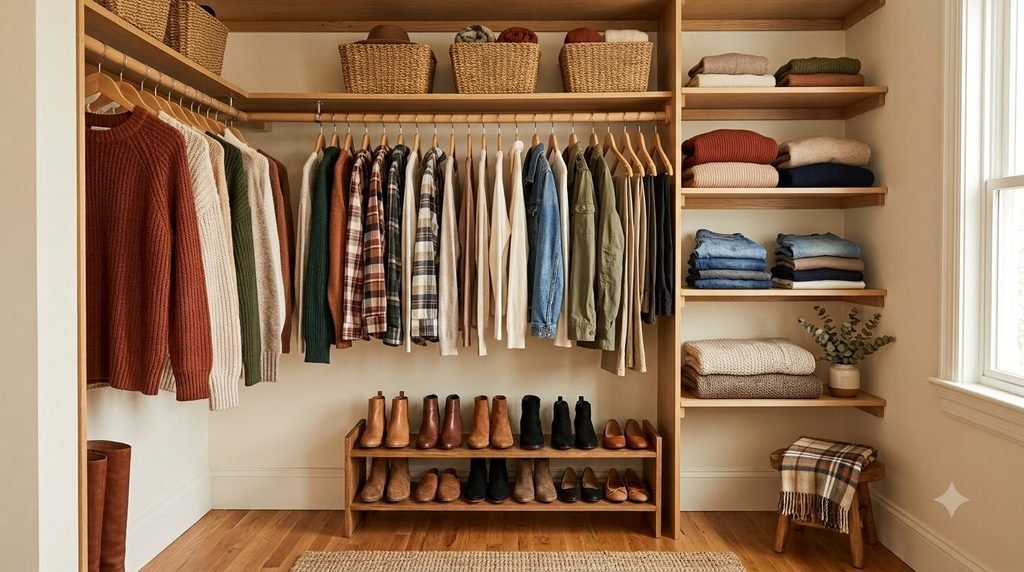
When summer starts winding down, your closet can quickly become harder to use. Lightweight clothes may still be taking up the easiest-to-reach space, while sweaters, jackets, jeans, and other fall layers are pushed toward the back.
A fall closet reset doesn’t mean taking everything out and starting over. The goal is to make the clothes you are most likely to wear easier to see, reach, and put away while moving genuinely seasonal items somewhere else.
In this guide, we’ll walk through practical ways to organize your closet for fall, from deciding what to store and what to keep accessible to arranging sweaters, shoes, accessories, and transitional pieces. You’ll also find simple storage ideas that can help prevent your closet from becoming overcrowded again.
1. Start With a Quick Closet Cleanout
Before you rearrange your fall wardrobe, take a few minutes to remove the clothes that no longer belong in your everyday rotation. You don’t need to empty the entire closet onto the floor. Instead, start with the clothes you can already see and quickly sort anything that is clearly worn out, no longer fits, hasn’t been worn in a long time, or doesn’t suit your current lifestyle.
I find it easier to make three simple groups: keep, donate, and store. Keep everyday pieces that you actually expect to wear this season. Donate items that are still in good condition but no longer earn their space in your wardrobe. Store genuinely seasonal pieces that you won’t need for the next few months.
A useful rule: don’t keep something in your prime closet space simply because you might wear it someday. Your easiest-to-reach space should be reserved for clothing that fits your current season and your actual routine.
Quick cleanout checklist:
- Remove clothes that no longer fit or feel comfortable.
- Set aside pieces you haven’t worn and realistically don’t expect to wear.
- Check for damaged items that need repair or replacement.
- Separate summer-only clothing before reorganizing fall pieces.
- Keep your most-used clothing in the easiest-to-reach areas.
2. Move Summer-Only Clothes Out of Prime Space
Once you’ve removed the obvious clutter, look at which clothes are taking up your most convenient storage space. Summer-only pieces such as swimsuits, beach cover-ups, lightweight shorts, and vacation clothing usually don’t need to stay at the front of your closet once fall arrives.
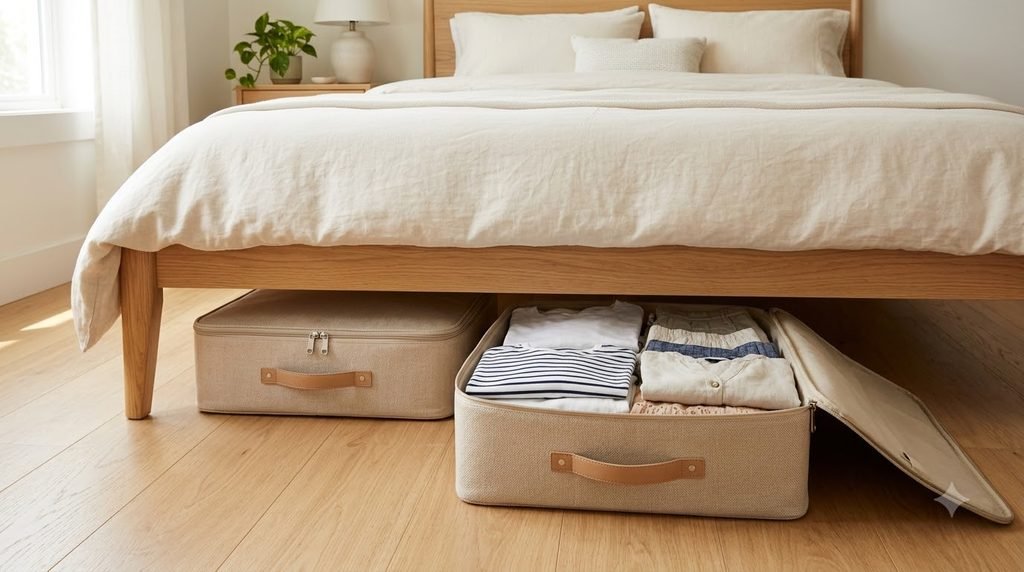
Move these items to a less accessible location, such as a high closet shelf, under-bed storage, or a separate seasonal bin. Keep the pieces you can still layer and wear during changing temperatures within easy reach. Lightweight tops, casual dresses, thin cardigans, and denim can often work well through the transition into fall.
Don’t pack away everything that looks “summer.” Early fall weather can still be warm, so focus on moving out clothing that you genuinely won’t use rather than following the calendar too strictly.
Before storing summer clothes:
Keep a small selection of transitional pieces accessible.
Wash or clean clothing before putting it away.
Make sure everything is completely dry.
Remove pieces you no longer wear instead of storing them for another year.
Use breathable storage where appropriate.
3. Bring Your Fall Clothes to Eye Level
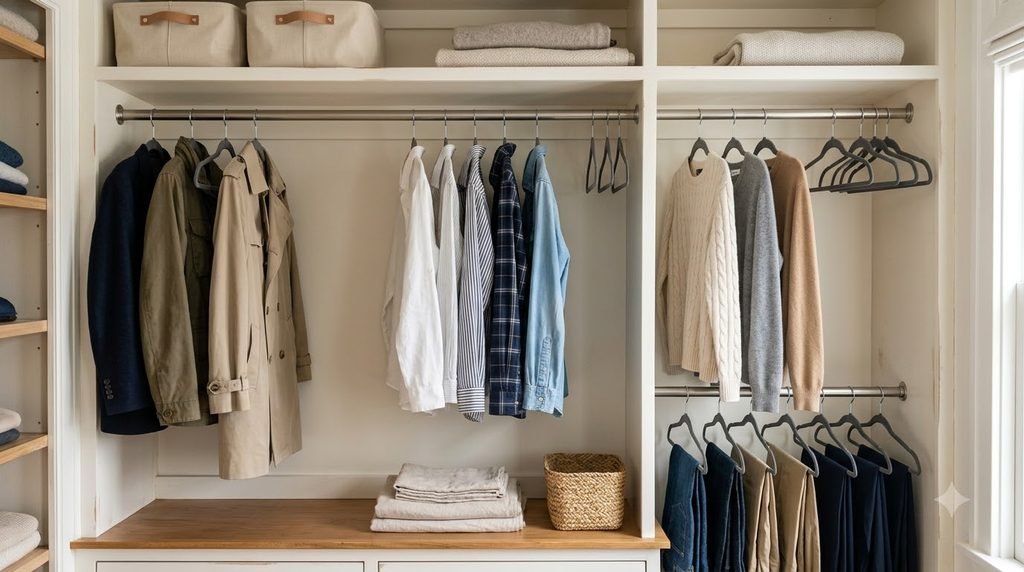
Your closet’s easiest-to-reach space should work for the season you’re actually living in. For fall, that usually means keeping sweaters, jeans, long-sleeve tops, lightweight jackets, and other frequently worn layers where you can see and reach them without moving several other pieces first.
This is especially helpful if your closet is small. Instead of trying to fit more clothing into the same space, make the existing space more useful by giving priority to the items you reach for most often. You can keep less frequently worn pieces on higher shelves or toward the back of the closet.
Think about your routine, not just the season. If you work from home most days, your everyday casual clothes may deserve the prime space. If you commute or dress more formally, workwear may need to be easier to access. Your closet should reflect how you actually get dressed.
A simple priority system:
Out-of-season clothing → higher shelves or separate storage
Most-worn fall clothes → easiest-to-reach space
Transitional pieces → nearby
Occasional clothing → secondary storage
4. Create a Transitional Clothing Section
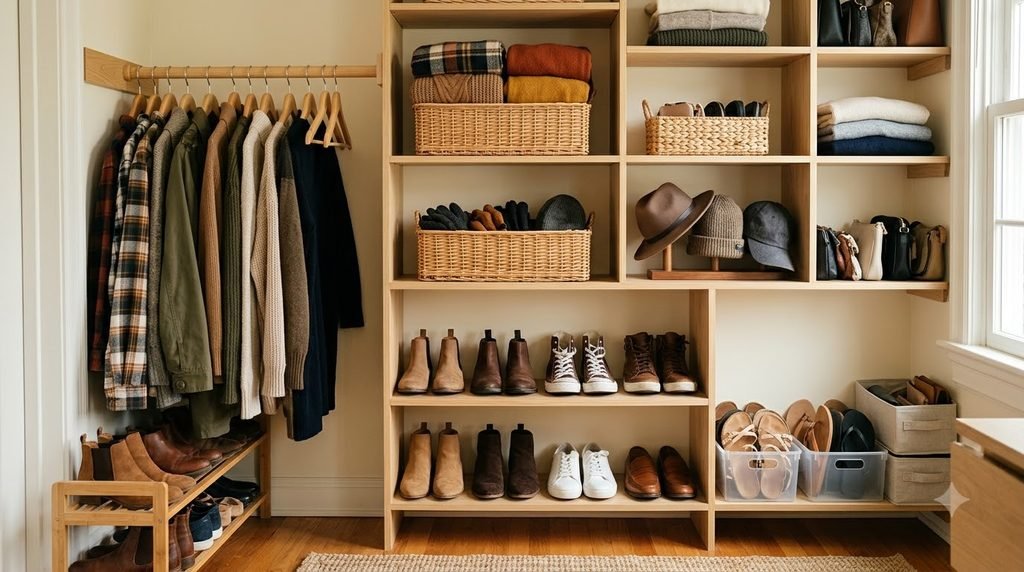
Early fall is usually the awkward part of seasonal wardrobe organization. Some days may feel cool enough for a sweater, while other days still call for lighter clothing. Instead of choosing between a completely summer or completely fall closet, create a small transitional section for pieces that work in both seasons.
Good examples include lightweight cardigans, denim jackets, long-sleeve shirts, lightweight trousers, casual dresses, and thin sweaters. Keep these pieces together rather than scattering them throughout the closet. That makes layering easier and prevents you from pulling summer storage back out every time the weather changes.
Keep this section intentionally small. The goal isn’t to create another category that takes over your closet. Choose the pieces you actually reach for during changing weather and leave the rest stored until temperatures consistently become cooler.
Easy transitional pieces to keep accessible:
Lightweight trousers and jeans
Lightweight cardigans
Denim or casual jackets
Long-sleeve cotton tops
Thin sweaters
Layer-friendly dresses
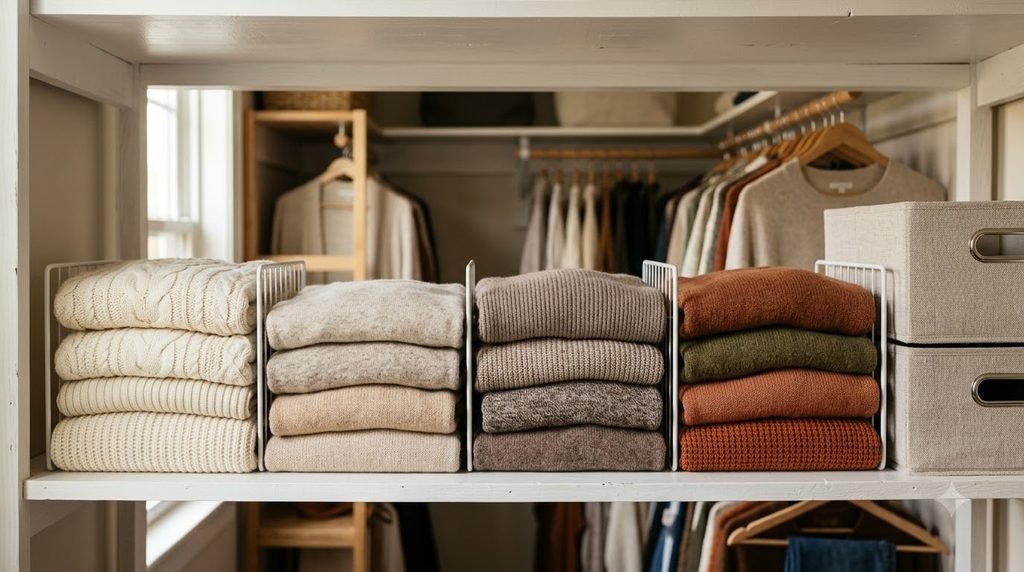
5. Organize Sweaters So They Don’t Take Over
Sweaters are useful in fall, but they can quickly consume a lot of closet space because they’re thicker than most summer clothing. Before deciding how to store them, consider which sweaters you actually wear and how often you reach for them.
If you have shelves, keep sweaters folded in manageable stacks rather than creating one tall pile. A shelf divider can help prevent different categories from mixing together. For deeper shelves, storing sweaters vertically in a row can sometimes make individual pieces easier to see and remove.
If shelf space is limited, use a dresser drawer or a breathable storage bin for less frequently worn sweaters. Avoid cramming too many pieces into one container—the moment you have to dig through a bin to find a specific sweater, the storage system becomes less useful.
A simple sweater rule: keep your most-worn sweaters at the easiest-to-reach height, while occasional or special-occasion pieces can go into secondary storage.
Before storing sweaters, check:
Which pieces can be donated if they’re no longer useful day.
Which ones you actually wear
Whether any need repair or cleaning
Whether your current storage prevents easy access
Whether you have enough room to add fall layers
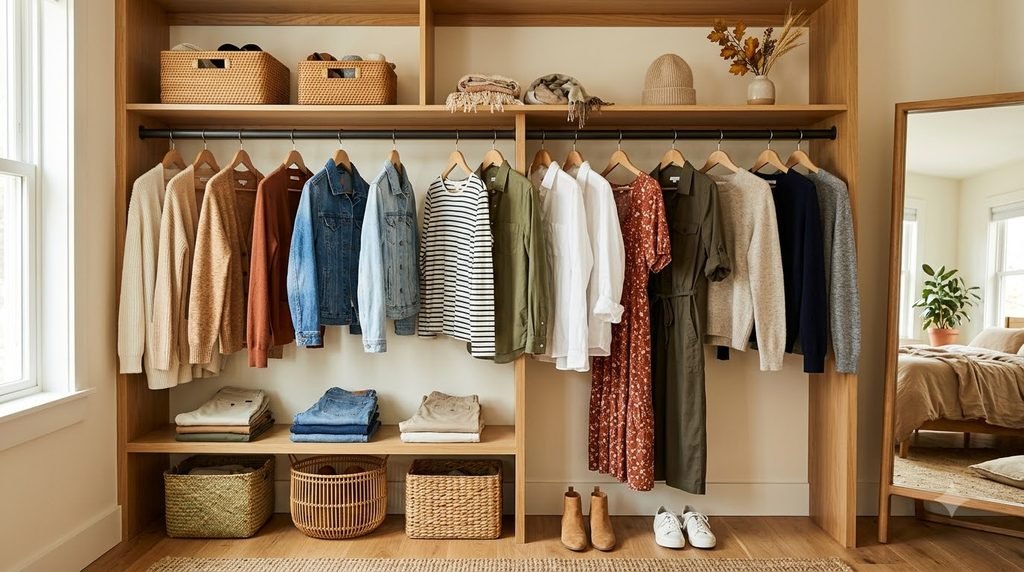
6. Give Jackets and Outerwear an Easy-to-Reach Home
Fall usually means reaching for jackets and lightweight outer layers more often, so give them a dedicated place instead of letting them collect on a chair, bed, or bedroom floor.
If you have enough closet rod space, keep your most-used jackets together near the front. If your closet is small, you don’t necessarily need another large piece of furniture. A few sturdy wall hooks, an over-the-door rack, or a narrow coat rack can provide a convenient temporary home for everyday outerwear.
Choose the storage based on how often you wear each piece. Your everyday jacket should be easy to grab and put away, while heavier coats or occasional outerwear can stay in a less accessible part of the closet.
The goal is to make putting a jacket away just as easy as taking it out. When storage is inconvenient, outerwear tends to become bedroom clutter.
For a simple fall outerwear system:
Leave enough space so jackets can be returned easily.g a pile on a chair or bedroom floor.
Keep everyday jackets within easy reach.
Store occasional outerwear in secondary space.
Use hooks for pieces you wear repeatedly.
Avoid overloading a single hook or rack.
7. Reorganize Your Closet Around How You Get Dressed
A closet can be perfectly organized and still feel difficult to use if the layout doesn’t match your daily routine. Instead of organizing everything only by clothing type, think about the order in which you actually get dressed.
For example, if you usually start with a top and jeans, keep those pieces close together. If you dress for work several days a week, keep your most-used workwear easy to reach. You can also group frequently paired items nearby so you don’t have to search through different parts of the closet every morning.
This approach is especially useful during fall because you’ll probably be combining more layers. Keeping sweaters, jeans, jackets, and other commonly paired pieces within the same general area can make getting dressed faster without requiring additional storage.
Try organizing around your routine:
- Keep everyday outfits in your easiest-to-reach area.
- Group frequently worn pieces near each other.
- Keep workwear separate if your daily clothing needs are different.
- Place fall layers where they’re easy to grab.
- Move rarely worn clothing away from prime storage space.
The best closet system isn’t necessarily the one that looks the most organized. It’s the one that makes your normal routine easier to follow.
8. Make Your Shoes Fall-Ready
Fall is a good time to look at your shoes because seasonal changes often reveal which pairs you actually use. Sandals and other warm-weather footwear may no longer need to occupy the easiest-to-reach space, while sneakers, boots, loafers, and other fall-friendly options become part of your regular rotation.
Start by taking a quick look at the shoes you currently keep in your closet. Remove pairs that are damaged beyond reasonable repair, uncomfortable, don’t fit, or simply aren’t being worn. There’s no benefit in giving valuable storage space to shoes you never reach for.
Next, move your most-used fall footwear to the most convenient location. If you have a shoe rack, keep everyday pairs where you can grab them without moving several other shoes. Less frequently worn or special-occasion shoes can go higher up or into secondary storage.
For a small closet, don’t try to display every pair at once. Keep the shoes you’re most likely to wear during fall accessible and store the rest neatly elsewhere.
A simple fall shoe reset:
- Remove damaged or uncomfortable pairs.
- Move summer-only footwear to secondary storage.
- Keep everyday sneakers and fall shoes easy to reach.
- Store special-occasion shoes separately.
- Leave enough space so shoes can be returned without creating a pile.
This small adjustment can make your closet easier to use without requiring additional furniture or storage.elp keep footwear contained without blocking your walking area.
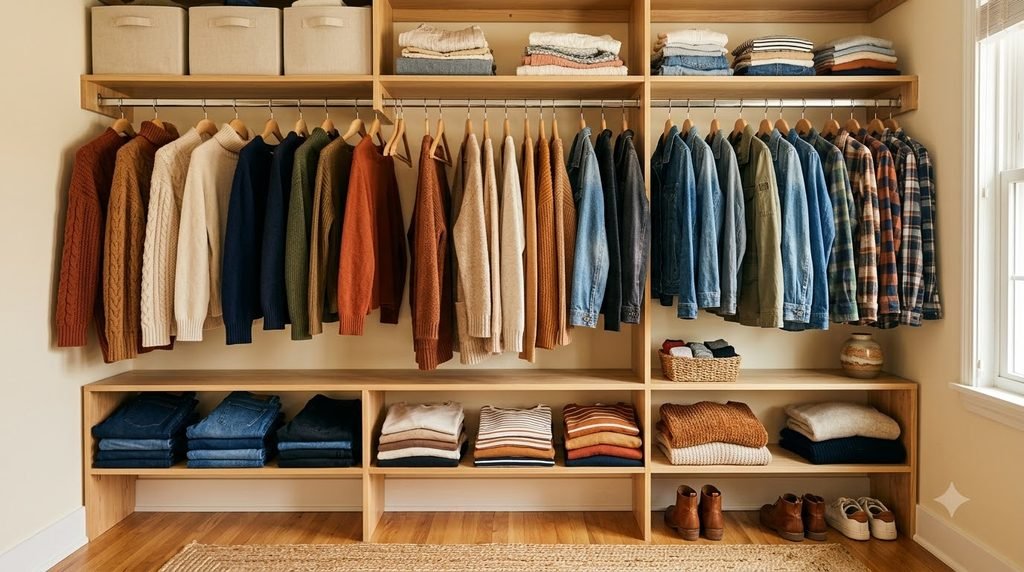
9. Use Bins for Seasonal Accessories
Fall accessories are easy to underestimate because individual items don’t take up much space. Scarves, gloves, hats, belts, and other small seasonal pieces can quickly become a messy collection when they don’t have a defined storage spot.
Instead of spreading these items across drawers and shelves, give your fall accessories one dedicated area. A small fabric bin, drawer organizer, or divided basket can work well depending on the amount of space you have.
Keep the accessories you use most often toward the front or top of the storage area. Less frequently worn pieces can go toward the back or into a separate container. If you’re using one large bin, consider smaller pouches or dividers inside it so similar items don’t become mixed together.
Don’t overfill the container. You should be able to see what you have without emptying the entire bin. If the container is already packed, use the seasonal reset as an opportunity to remove accessories you no longer wear.
A practical accessory storage system:
- Keep fall accessories together in one designated area.
- Separate small categories with dividers or smaller pouches.
- Keep frequently used items easiest to reach.
- Store occasional pieces separately.
- Leave enough room to add or remove items without creating a mess.
This keeps small accessories contained while making them much easier to find when the weather gets cooler.
10. Switch to a More Consistent Hanger System
A mix of bulky plastic hangers, thin wire hangers, and mismatched shapes can make a closet feel more crowded than it actually is. Fall is a good time to simplify the system, especially before adding heavier sweaters, jackets, and other layers.
You don’t need to replace every hanger at once. Start with the clothes you use most often and gradually switch to a consistent style that fits your wardrobe and closet space. Slim hangers can help maximize hanging space, while sturdy hangers are more appropriate for heavier jackets and coats.
The important part is consistency. When hangers have a similar shape and thickness, clothes tend to sit more evenly on the rod and it becomes easier to see what you own.
Before buying new hangers, check:
- How much hanging space you actually have.
- Whether your existing hangers are strong enough for heavier fall clothing.
- Which clothing items need special support.
- Whether slim hangers would meaningfully increase available space.
- How many hangers you realistically need.
Avoid buying a large pack simply because it seems like a good deal. Measure your available rod space first and replace hangers gradually if your current ones are still usable.
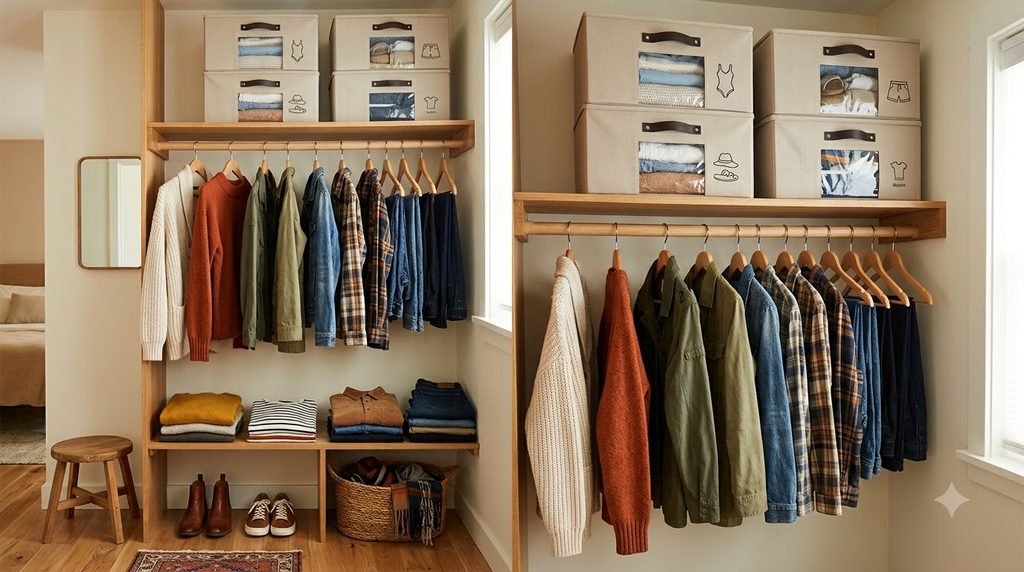
11. Leave Some Breathing Room Between Clothes
A closet doesn’t need to be packed to its maximum capacity to be useful. When clothes are pressed tightly together, it’s harder to see what you own, remove one item without disturbing the others, and put clothes back after wearing them.
As you bring your fall wardrobe forward, try to leave a small amount of space between groups of clothing. You don’t need a huge gap between every hanger. The goal is simply to avoid creating one tightly compressed row that becomes difficult to use.
If your closet doesn’t have enough room for everything, that’s a sign to review what deserves prime hanging space rather than immediately buying more storage. Move rarely worn or genuinely out-of-season pieces elsewhere first.
A little breathing room helps because it makes it easier to:
See individual clothing pieces.
Remove clothes without pulling several hangers along.
Return clothing to the correct place.
Notice items you aren’t actually wearing.
Keep your closet looking organized for longer.
If your closet becomes crowded again after a few weeks, don’t simply rearrange everything. Revisit the clothes taking up the most space and decide whether they still belong in your everyday rotation.
12. Create a Small “Maybe” Area
Not every item in your closet needs an immediate yes-or-no decision. Sometimes you’re unsure whether you’ll wear something again, especially when you’re changing from one season to another.
Instead of putting these clothes back into your main wardrobe, create a small “maybe” area. This could be one shelf, a small section of a drawer, or a clearly labeled storage bag. The important part is keeping the category limited so it doesn’t become an excuse to keep everything.
Give these items a specific review date, such as the end of fall. If you don’t reach for a piece during the season, that’s useful information when you decide what to keep, donate, or store next.
Use the “maybe” area for items such as:
- Clothes you’re unsure you’ll wear this season.
- Pieces that don’t currently fit your routine.
- Items you’re considering replacing.
- Clothing you haven’t worn recently but aren’t ready to donate.
Keep this area intentionally small. If it starts filling an entire shelf or several drawers, it’s time to make some firmer decisions.
This approach makes seasonal decluttering less stressful because you don’t have to make every decision immediately, while still preventing uncertain items from taking over your prime closet space.
13. Store Seasonal Clothes Properly
Once you’ve decided which summer clothes won’t be needed during fall, store them in a way that protects the clothing without making next season’s reset difficult. Good seasonal storage doesn’t have to be expensive, but it should keep clothes clean, dry, and easy to identify.
Before storing anything, make sure the clothing is clean and completely dry. Storing worn or damp items can lead to unpleasant odors and can make it harder to assess their condition when you unpack them later.
Choose the storage method based on the clothing and the space available. Foldable items can work well in labeled bins or drawers, while delicate or easily wrinkled pieces may need a different approach. If you’re using containers, avoid packing them so tightly that clothes become difficult to remove.
Label seasonal storage clearly. A simple label such as “Summer Clothes” or “Warm Weather Accessories” can save time when you’re looking for something later.
Before putting summer clothes away:
- Wash or clean everything first.
- Make sure clothing is completely dry.
- Remove damaged or unwanted pieces instead of storing them.
- Use suitable containers for the type of clothing.
- Label containers so they’re easy to identify.
- Keep stored clothing somewhere clean and dry.
The goal is not simply to hide summer clothes until next year. Good seasonal storage should free up useful closet space now while making the next wardrobe transition easier.
14. Use the Space Under Your Bed for Seasonal Storage
If your closet is already close to full, the space under your bed can provide useful seasonal storage without taking up additional floor space. It’s particularly helpful for clothing and accessories that you won’t need regularly during fall.
Before using the space, check that it stays clean and dry. Low-profile storage containers or zippered fabric bags can work well because they’re easier to slide out when you need something.
Keep the items you access least often underneath the bed. For example, if you’ve already moved summer-only clothing out of your closet, this can be a good place to store those pieces until the weather changes again.
Avoid turning the area into a catch-all. If you can’t remember what’s underneath your bed, the storage isn’t really helping. Group similar items together and label containers when necessary.
For better under-bed storage:
- Use low-profile containers that fit comfortably.
- Store clean, completely dry clothing.
- Group similar seasonal items together.
- Label containers so you know what’s inside.
- Keep frequently needed items somewhere easier to access.
- Leave enough room to remove containers without disturbing everything else.
Under-bed storage works best as an extension of your seasonal storage system—not as a place to hide things you don’t know what to do with.
Related: You can also see our guide to 12 Small Space Organization Ideas to Make Your Home Feel Bigger for more ways to use overlooked storage areas.
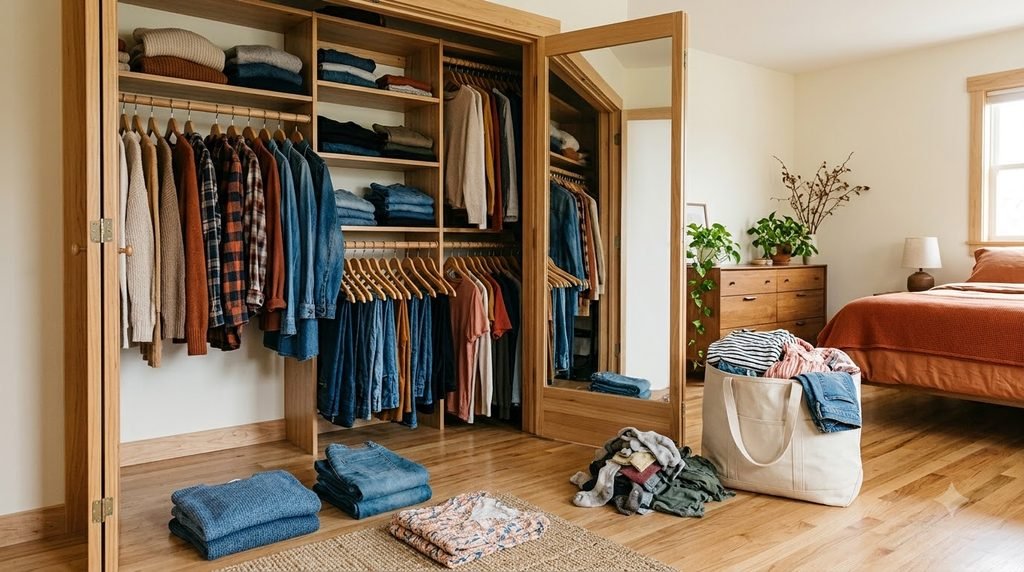
15. Finish With a Simple Fall Closet Reset Routine
Once your fall clothes are in place, the goal is to keep the system easy enough that you can maintain it. You don’t need to reorganize your entire closet every week. A short reset every few days can prevent clothes from gradually ending up on the wrong shelf, floor, or chair.
Start by returning anything that has been left out, then check whether your most-used fall clothing is still easy to reach. If a particular category keeps becoming messy, that’s usually a sign that the storage system needs to be simplified rather than reorganized again and again.
You can also use the end of each week to notice what you’re actually wearing. If several pieces have stayed untouched while other clothes are constantly in rotation, consider whether those unused items really need prime closet space.
A simple weekly fall closet reset can take just a few minutes:
- Put worn clothing back in its proper place.
- Return shoes and accessories to their storage areas.
- Fold or hang anything that has become messy.
- Check that everyday fall pieces are still easy to reach.
- Move items that don’t belong in the current season.
- Remove any new clutter before it builds up.
The best result of a fall closet reset isn’t a perfectly styled closet. It’s a closet that remains easy to use as your routine changes throughout the season.
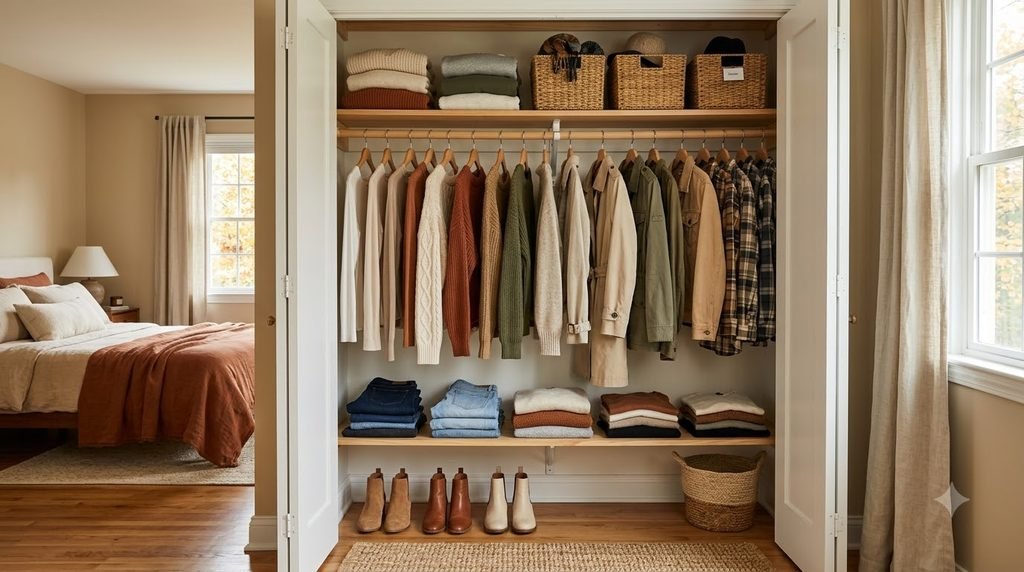
How to Organize a Small Closet for Fall
A small closet doesn’t need to hold your entire wardrobe at the same time. The key is to make the limited space work around what you actually wear during fall.
Start by giving your easiest-to-reach space to the clothing you use most. Move summer-only pieces and rarely worn items to higher shelves, under-bed storage, or another suitable location. This creates room without requiring you to add more furniture.
Use vertical space wherever possible. Slim hangers can reduce wasted space on the closet rod, while shelf dividers, small bins, and labeled containers can help keep folded clothing and accessories contained.
Avoid creating too many categories. In a small closet, a simple system is usually easier to maintain than separating every type of clothing into its own section.
For a small fall closet, prioritize:
- Everyday fall clothing
- Transitional layers
- Frequently worn shoes
- A small selection of seasonal accessories
- Easy access to your most-used pieces
If everything still doesn’t fit comfortably, don’t immediately add another storage solution. First ask whether every item needs to remain in the closet during fall. Reducing what occupies prime space is often more effective than trying to squeeze more into the same area.
What Should You Remove From Your Closet Before Fall?
A seasonal closet reset is a good opportunity to remove clothing that no longer earns valuable storage space. This doesn’t mean getting rid of everything you haven’t worn recently. Instead, focus on items that are clearly no longer useful for your current wardrobe.
Start with clothing that no longer fits, feels uncomfortable, or is damaged beyond practical repair. Then look at pieces you repeatedly skip when getting dressed. If something has remained untouched through multiple seasons, it’s worth asking whether you realistically expect to wear it again.
Also look for duplicate items. If you own several similar sweaters, jackets, or pairs of jeans but consistently reach for only one or two, you may be able to free up space without losing anything important.
Consider removing or relocating:
- Clothing that no longer fits or feels comfortable.
- Damaged pieces that aren’t worth repairing.
- Items that no longer suit your lifestyle.
- Duplicates you rarely use.
- Summer-only clothing you won’t need during fall.
- Pieces you’ve repeatedly avoided wearing.
If you’re unsure about an item, don’t force yourself to make the decision immediately. Place it in the small “maybe” area you created and review it later in the season.
The goal isn’t to own as few clothes as possible. It’s to make the space you have easier to use by giving priority to clothing that genuinely belongs in your current routine.
Common Fall Closet Organization Mistakes
A fall closet reset can look organized on day one and still become difficult to maintain if the system doesn’t match your space or routine. A few common mistakes can make a closet feel crowded again surprisingly quickly.
1. Keeping everything in the closet year-round
When seasonal clothing stays in prime space all year, there’s less room for the pieces you’re actually wearing. Move genuinely out-of-season items to suitable secondary storage.
2. Buying storage before decluttering
More bins and organizers don’t solve the problem if you’re storing clothing you don’t use. Decide what deserves space first, then choose storage for what remains.
3. Packing shelves and bins too tightly
If you have to pull everything out to reach one sweater or accessory, the system isn’t practical. Leave enough room for easy access.
4. Organizing for appearance instead of routine
A closet may look impressive but still be inconvenient if everyday clothes are difficult to reach. Arrange your storage around how you actually get dressed.
5. Ignoring transitional weather
Moving every summer item out at once can leave you unprepared for warmer fall days. Keep a small selection of lightweight layers accessible.
6. Creating too many categories
Overly complicated systems are harder to maintain. Use enough categories to make things easy to find, but keep the system simple enough that you can put everything away quickly.
A useful fall closet system should reduce daily friction, not create another chore. If you repeatedly struggle to put something away, treat that as feedback that the storage arrangement needs to change.
A Simple Fall Closet Reset Checklist
Once you’ve finished reorganizing your closet, use this checklist to make sure the most important changes are in place. You don’t need to complete everything in one session. If your closet is small or heavily cluttered, work through the list in stages.
Fall Closet Reset Checklist
☐ Remove clothing that no longer fits, works for your lifestyle, or is too damaged to keep.
☐ Move summer-only clothing into suitable seasonal storage.
☐ Bring frequently worn fall clothing into the easiest-to-reach areas.
☐ Create a small section for transitional clothing.
☐ Fold and store sweaters so individual pieces are easy to access.
☐ Give everyday jackets and outerwear a convenient home.
☐ Review your fall shoes and remove pairs you no longer use.
☐ Keep scarves, hats, gloves, and other accessories together.
☐ Replace only the hangers that are no longer practical.
☐ Leave enough space to see and return clothing easily.
☐ Put uncertain pieces into a limited “maybe” area for later review.
☐ Label seasonal storage so it’s easy to find next time.
After completing the checklist, take a quick look at the closet from the perspective of your normal morning routine. The clothes you reach for most should be easy to see and access. If something still feels inconvenient, change the system now rather than waiting for the closet to become cluttered again.
Final Thoughts
Organizing your closet for fall doesn’t have to mean buying new storage or completely starting over. A more useful approach is to make a few intentional changes based on what you actually wear, how much space you have, and how your daily routine works.
Bring frequently worn fall clothing forward, move genuinely out-of-season pieces into secondary storage, and give sweaters, shoes, jackets, and accessories a defined place. Most importantly, leave enough room for the system to remain easy to use.
If your closet is small, focus on reducing what occupies prime space before adding more organizers. And if you’re unsure about certain pieces, give yourself time to decide rather than forcing everything into a keep-or-donate decision immediately.
A good fall closet reset should make getting dressed and putting things away easier—not create another project to maintain. Once you’ve found an arrangement that works for your routine, a few minutes of regular upkeep can help keep it that way throughout the season.
Related Articles
- 15 Closet Organization Ideas to Maximize Your Storage Space
- 12 Small Space Organization Ideas to Make Your Home Feel Bigger
- 15 Simple Home Organization Ideas That Make Everyday Life Easier
- 17 Things to Declutter in September for a More Organized Home
- 31 Fall Home Reset Ideas That Make Your Home Easier to Live In