A coffee station can make a kitchen feel more organized—but in a small kitchen, it can just as easily become another source of clutter.
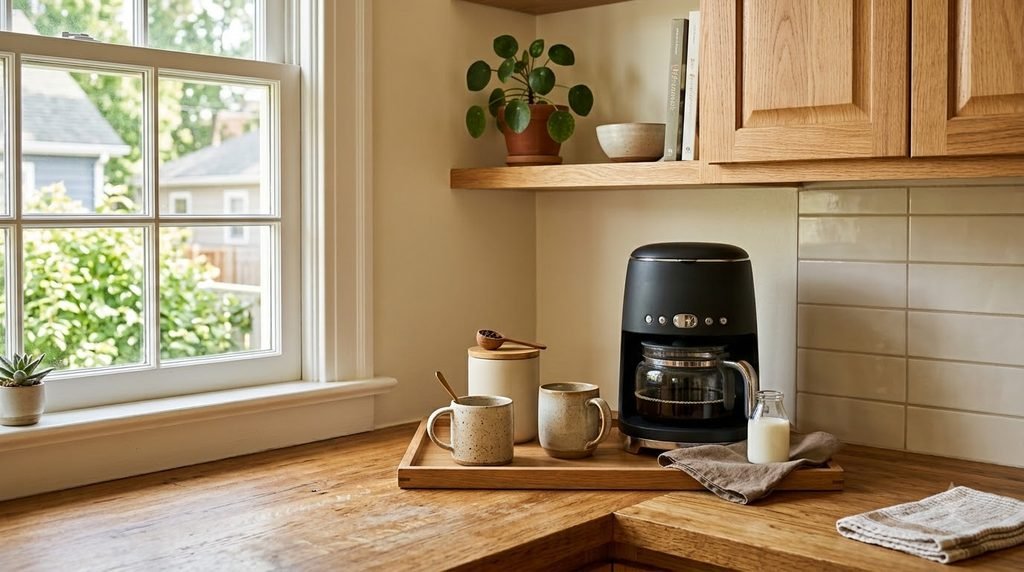
The coffee maker needs counter space. Mugs need a home. Coffee, filters, pods, syrups, spoons, and other supplies need to stay close enough to use every morning. If everything simply gets placed around the machine, your coffee corner can quickly take over the counter.
The better approach is to create a compact coffee zone around the way you actually make coffee.
You might use one section of counter, a narrow shelf, an unused corner, a rolling cart, a cabinet, or even a drawer. The goal isn’t to create a picture-perfect coffee bar with every accessory. It’s to make your morning routine easier while keeping valuable kitchen space available for cooking and food preparation.
These 15 coffee station ideas for small kitchens focus on practical layouts, storage, and organization so you can create a coffee setup that works without taking over the room.
1. Start With One Clearly Defined Coffee Zone
The easiest way to make a small coffee station work is to give it a clear boundary.
Instead of placing the coffee maker wherever there happens to be an empty spot, choose one compact area and make that the coffee zone.
It could be:
- One end of the countertop
- A corner near the refrigerator
- A section underneath an upper cabinet
- A narrow kitchen cart
- A small shelf
- One cabinet section
Keep your most frequently used coffee supplies within this zone.
For example, your daily setup might include the coffee maker, your favorite mugs, coffee beans or pods, and one small container for accessories.
Everything else can be stored nearby but out of sight.
This prevents coffee supplies from slowly spreading across the entire kitchen.
Small-kitchen rule: The coffee station should have a boundary. Once you know where it begins and ends, it becomes much easier to keep organized.
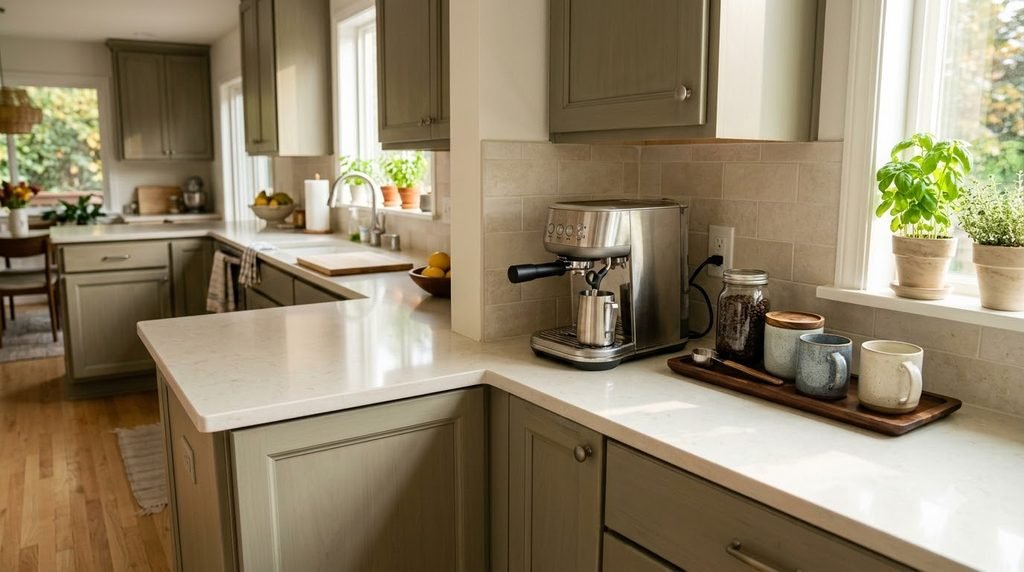
2. Use an Unused Corner of the Counter
Don’t overlook awkward corners.
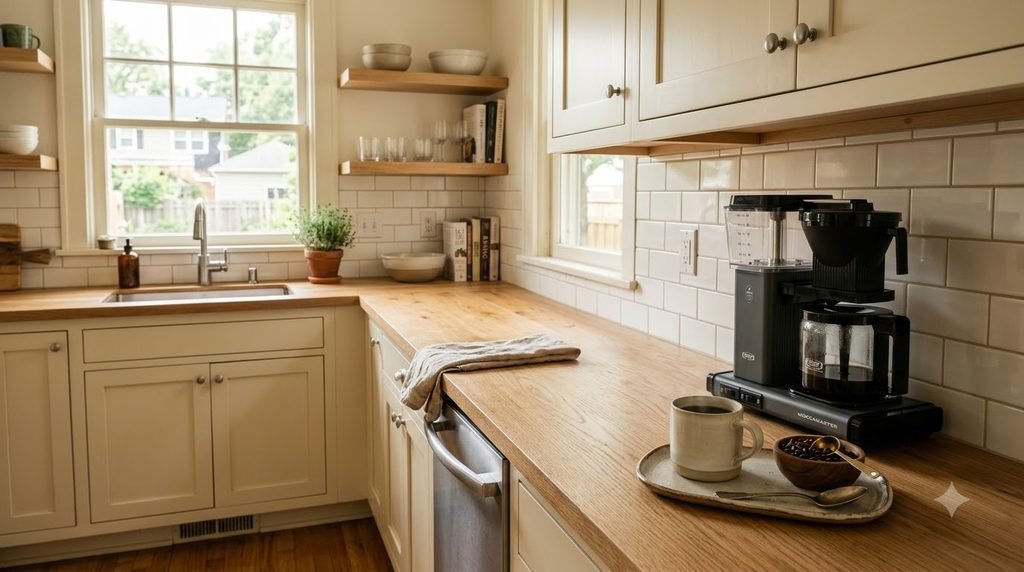
The end of a countertop or a corner that rarely gets used can be a surprisingly useful location for a coffee station. Recent small-kitchen coffee-station examples frequently recommend reclaiming these underused zones rather than trying to create an entirely new piece of furniture.
A corner works especially well when the coffee maker can sit against the wall while the supplies stay beside or underneath it.
You can add:
- A small tray
- One mug rack
- A compact container for coffee
- A narrow shelf
- A small canister for filters
Keep the center of your kitchen counter available for food preparation.
The goal is to use forgotten space, not valuable workspace.
3. Put the Coffee Maker Near a Convenient Outlet
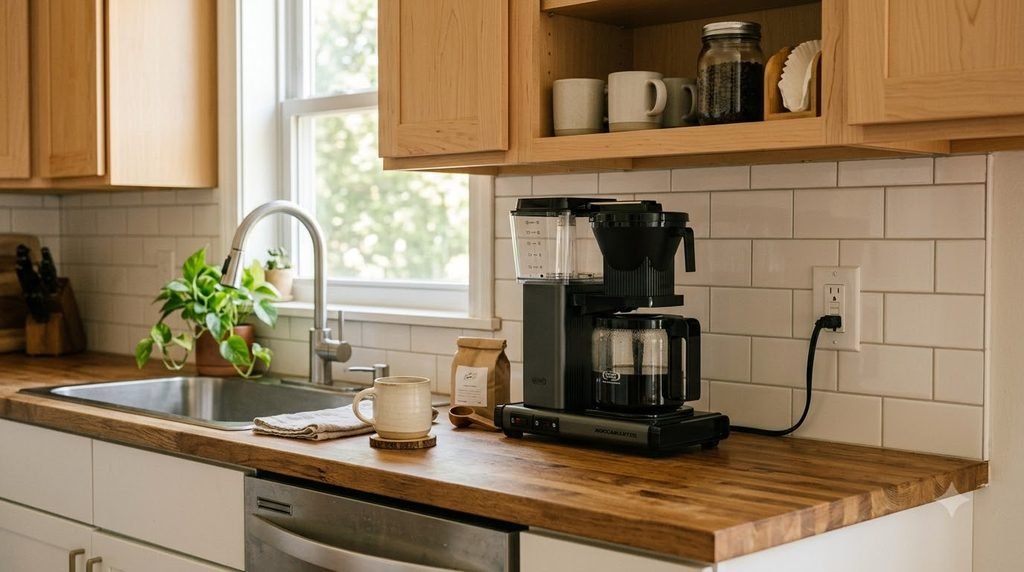
Before choosing the prettiest location, check the practical details.
Your coffee maker, espresso machine, kettle, or other appliance needs a safe and convenient power source.
The outlet should be accessible without stretching cords across the counter or placing them where they can interfere with normal kitchen work.
If possible, also consider how close the station is to water.
A useful coffee setup generally works best when the coffee machine, water source, and storage are reasonably close together. Recent kitchen-design guidance describes this as a functional “coffee maker triangle”: power, water, and storage should work together rather than forcing you to move back and forth across the kitchen.
Before settling on a location, ask:
Can I make coffee here without repeatedly walking across the kitchen?
If not, another location may work better.
4. Use a Tray to Contain the Coffee Station
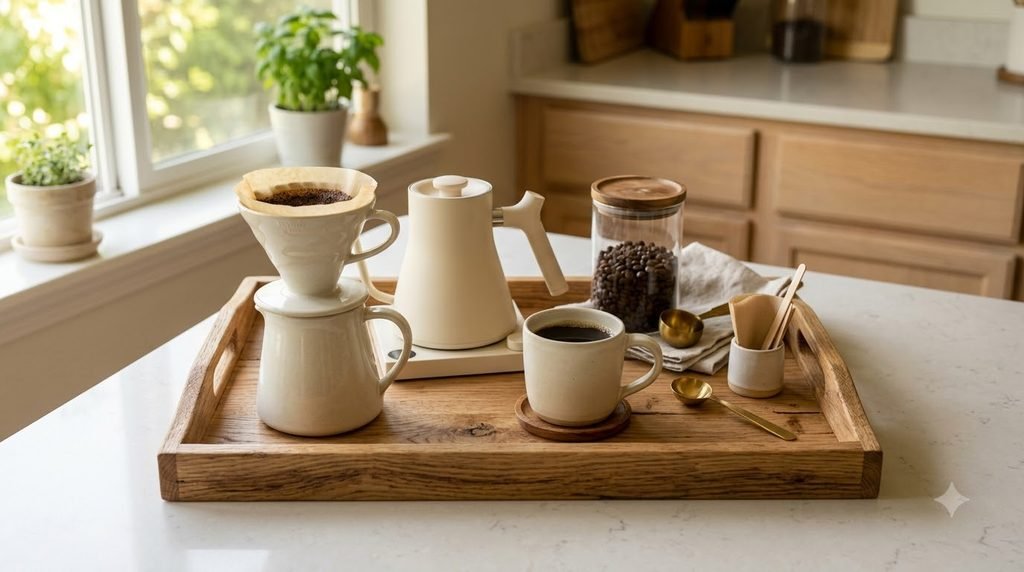
A tray is one of the simplest ways to make a small coffee station feel organized.
Place the coffee maker on a sturdy tray if the size and weight allow it, or use a tray beside the machine to hold everyday supplies.
A tray can contain:
- Coffee beans
- Sugar
- Stirring spoons
- Filters
- Small syrup bottles
- A favorite mug
The visual benefit is just as important as the organizational benefit.
Instead of several small objects appearing randomly across the countertop, the tray creates a defined area.
It also makes cleaning easier because you can move several small items at once.
For renters or anyone who doesn’t want to install shelves, this is one of the easiest ways to create a coffee station with almost no permanent changes.
5. Take Coffee Storage Vertical
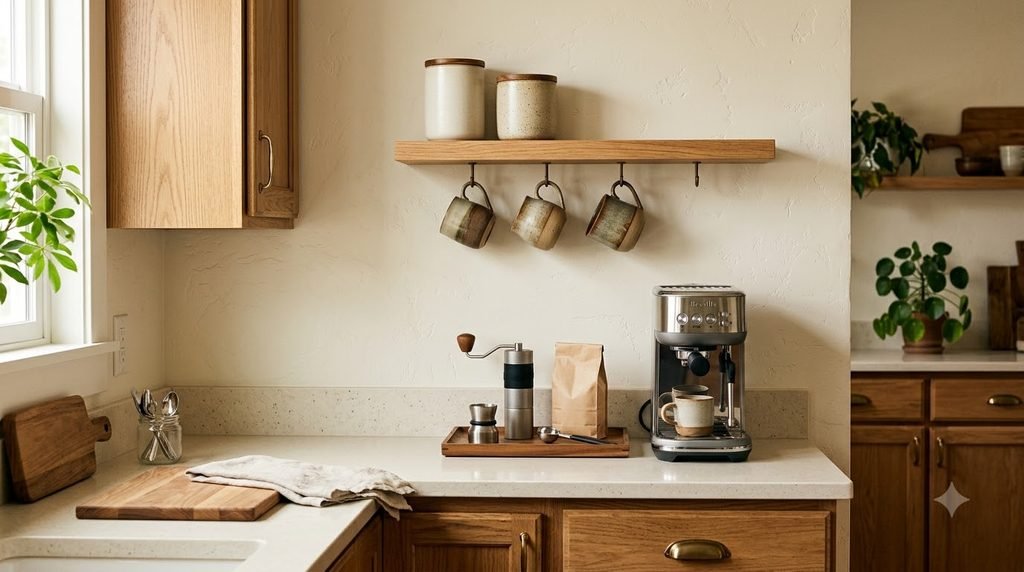
When countertop space is limited, look at the wall above the station.
A narrow shelf can hold coffee beans, filters, mugs, or a few decorative pieces without taking up additional counter width.
You could also consider:
- A wall-mounted mug rack
- A small floating shelf
- Hooks underneath a shelf
- A pegboard
- A narrow tiered organizer
Vertical storage is particularly useful in small kitchens because it moves items upward instead of spreading them horizontally. This is a recurring recommendation across current small-kitchen coffee-station guides.
Just don’t fill every inch of wall space.
Keep the most frequently used items accessible and leave enough open space for the station to feel visually calm.
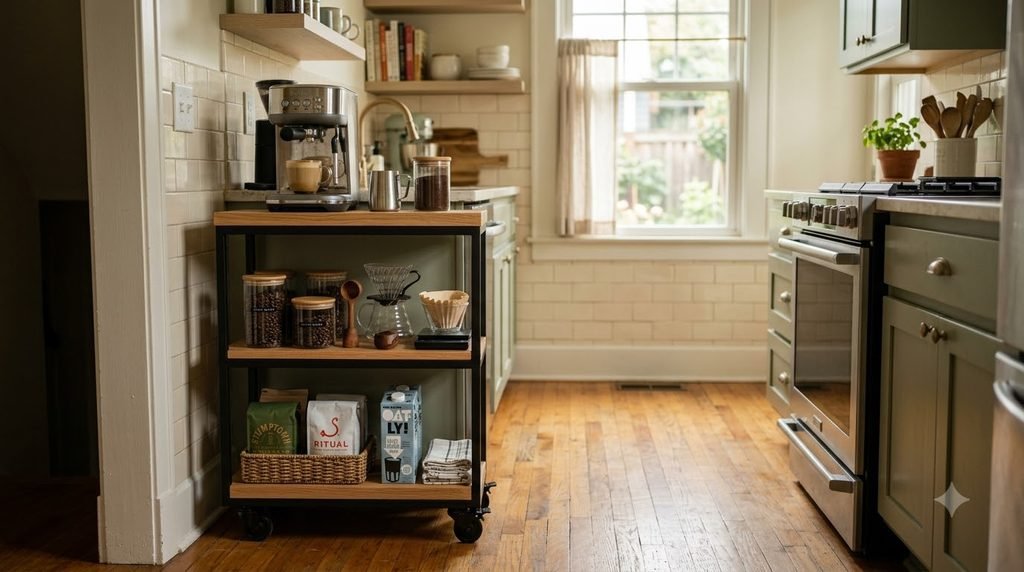
6. Use a Narrow Rolling Cart
A slim rolling cart can create a coffee station without permanently taking over your countertop.
This can be especially useful if you have limited counter space or need the coffee setup to serve more than one purpose.
For example:
Top level: coffee maker and daily mug
Middle level: coffee beans, filters, and accessories
Bottom level: backup supplies or less frequently used items
The biggest advantage is flexibility.
You can position the cart near an outlet while making coffee and move it when you need more kitchen workspace.
A cart can also work well in a rental where installing cabinets or shelves isn’t practical.
Before buying one, measure both the cart and the space where you plan to store it. A cart that technically fits but blocks a walkway or cabinet door isn’t actually saving space.
7. Turn One Cabinet Into a Hidden Coffee Station
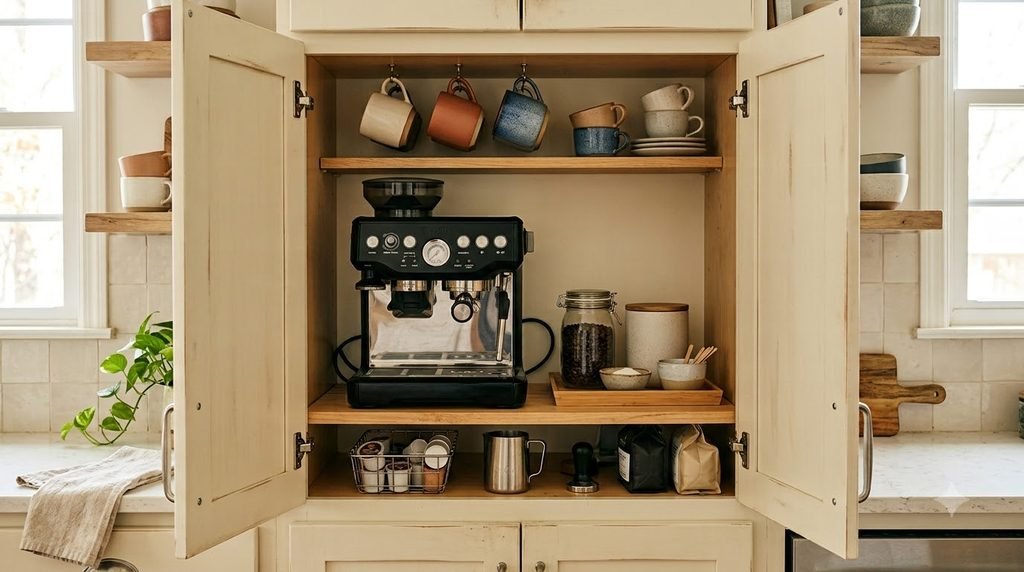
If you don’t want your coffee equipment visible all day, consider using an existing cabinet as a compact coffee station.
This can work particularly well if you have a cabinet with enough depth and appropriate clearance.
Keep the machine and daily supplies together, then close the doors when the kitchen needs to look cleaner.
However, don’t put a heat- or steam-producing coffee appliance into an enclosed cabinet without checking the appliance manufacturer’s clearance and ventilation requirements.
Steam from coffee machines and espresso equipment can affect cabinetry, and insufficient clearance can make filling or operating the machine awkward. Recent guidance specifically warns about steam and restricted cabinet clearance around coffee machines.
Function comes before appearance.
A hidden station is only useful if the appliance can be operated safely and comfortably.
8. Give Your Mugs a Smaller Footprint
Mugs can quickly become the biggest visual part of a coffee station.
You don’t need to display your entire mug collection next to the coffee maker.
Keep your everyday mugs within easy reach and move backup or seasonal mugs into a cabinet.
Depending on your kitchen, you could use:
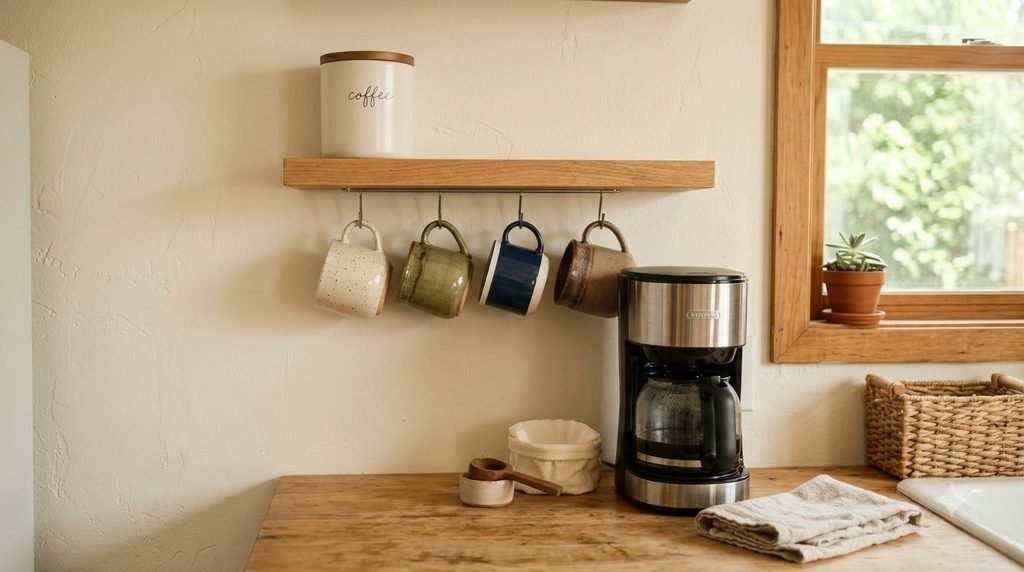
- Under-shelf mug hooks
- A small wall rack
- One narrow shelf
- A compact mug stand
- An existing cabinet shelf
If you have several favorite mugs, choose a small group that fits the space instead of letting every mug compete for attention.
A coffee station usually feels more organized when the mugs match the scale of the station.
9. Keep Daily Coffee Supplies Within Reach
One common mistake is putting the coffee maker in one location while storing everything else across the kitchen.
That makes a small coffee station less useful.
Think about the actual sequence of your morning routine:
Coffee → filter or pod → water → mug → brewing → sweetener or milk → cleanup
Try to keep the items you use every day within a few steps of one another.
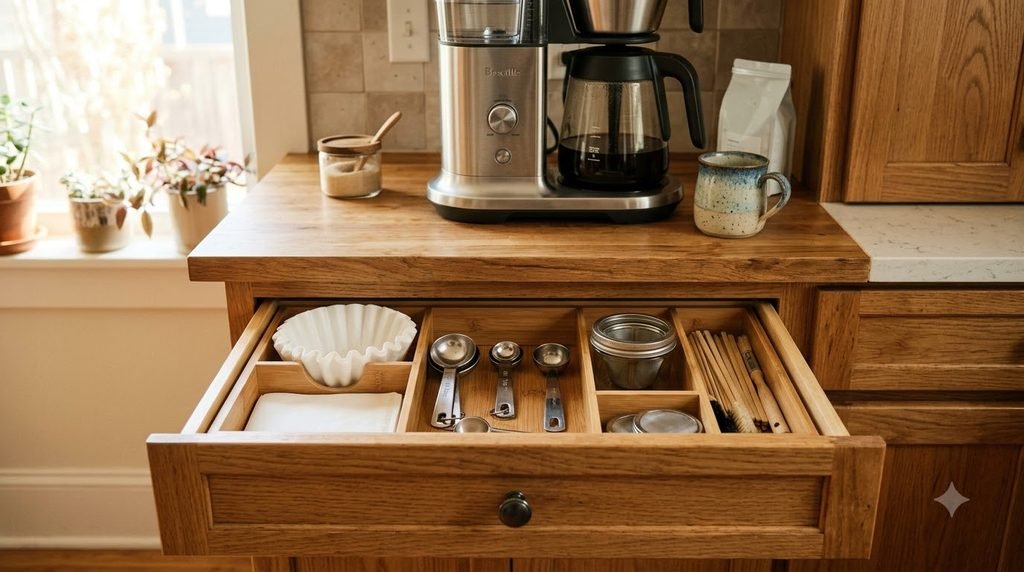
For example, a drawer directly below the station could hold filters, measuring spoons, and pods.
A nearby cabinet could hold coffee beans and backup supplies.
The goal isn’t to keep everything visible.
It’s to keep daily-use items accessible and backstock stored elsewhere.
This distinction is one of the easiest ways to keep a small coffee station from becoming crowded.
10. Use a Drawer for Coffee Accessories
If your countertop is already crowded, don’t add more containers.
Use a drawer.
A shallow drawer near the coffee maker can hold:
- Filters
- Measuring spoons
- Coffee scoops
- Stirring sticks
- Pod accessories
- Small reusable tools
Drawer dividers can keep small items from becoming a mixed-up pile.
This is particularly useful when your kitchen has plenty of cabinet storage but very little open counter space.
The coffee station then becomes more of a workflow zone than a decorative display.
And when you’re finished making coffee, most of the small accessories disappear back into the drawer.
11. Create a Coffee Station on a Floating Shelf
A floating shelf can work when you have a little wall space but almost no spare counter space.
The shelf could hold:
- Coffee canisters
- Mugs
- Filters
- Small decorative pieces
- Syrups
The coffee maker itself can remain on the nearest safe counter area.
This setup keeps the supplies visually connected while using vertical space.
Make sure the shelf is properly mounted and rated for the weight of whatever you plan to store on it.
You also want enough clearance for mugs and containers to be removed easily.
The best shelf is not necessarily the largest one.
In a small kitchen, a narrow shelf with carefully selected essentials can be much more useful than a deep shelf that encourages you to accumulate more supplies.
12. Try a Coffee Station on the End of a Cabinet Run
The end of a cabinet run is another frequently overlooked location.
If you have a small stretch of counter at the edge of your kitchen, it can become a dedicated coffee zone without interfering with the main food-preparation area.
Place the coffee maker toward the back.
Keep daily supplies beside it.
Use the cabinet above or below for storage.
This works especially well because the station naturally has a boundary: the cabinet edge defines one side and the wall or appliance defines another.
You don’t need a dedicated coffee-bar cabinet.
You simply need to give an existing part of the kitchen a specific job.
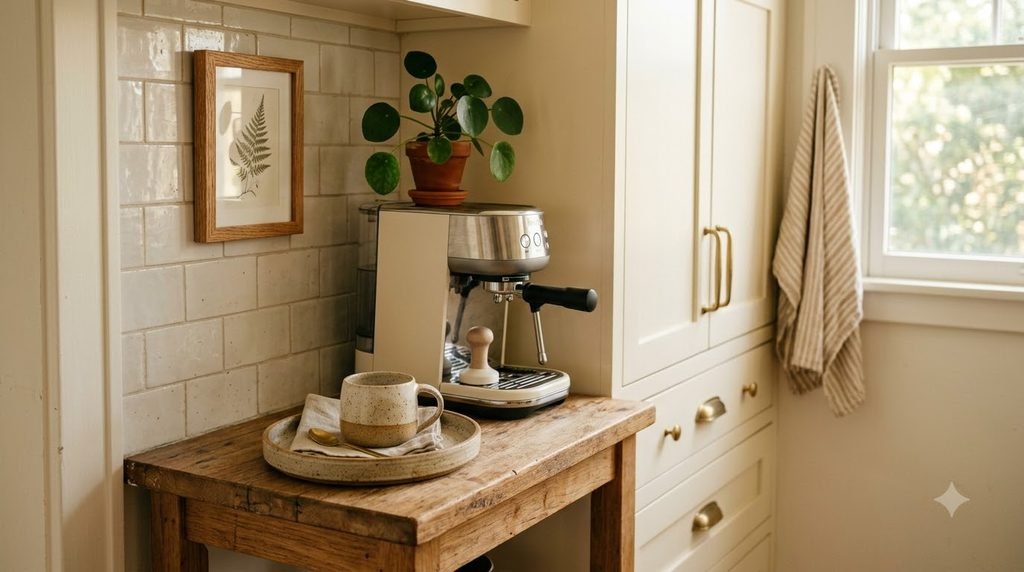
13. Make a Small Coffee Nook Feel Intentional
A small coffee station doesn’t have to look purely functional.
You can give it some personality without adding unnecessary clutter.
Try adding one or two visual elements:
- A favorite ceramic mug
- A small framed print
- A warm-toned coffee canister
- A small plant
- A simple tray
- A vintage-inspired sign
The key is restraint.
If the coffee maker, mugs, syrups, containers, and accessories already fill the area, adding more decor won’t improve it.
Instead, choose one visual feature that gives the station some character.
Pinterest’s current Home Café Engineering trend is partly about the look and ritual of making coffee at home, not simply owning coffee equipment.
That makes a small coffee station a natural place to combine function and personality.
14. Use a Hidden or Pull-Out Setup When Counter Space Is Extremely Limited
If you have almost no permanent counter space, consider a setup that can be put away when you’re finished.
Depending on your kitchen, this might mean:
- A pull-out appliance shelf
- A dedicated drawer for smaller coffee equipment
- A cabinet station
- A rolling cart
- A removable tray setup
The advantage is that the kitchen can return to its normal cooking function after breakfast.
But be careful with appliance weight, ventilation, heat, steam, and access.
A pull-out shelf should be strong enough for the equipment, and the appliance should have the clearances recommended by its manufacturer.
The prettiest storage solution isn’t useful if you can’t safely operate the machine.
15. Design the Station Around Your Actual Coffee Routine
This is the most important idea on the list.
Don’t design your coffee station around a photograph you saw online.
Design it around what you actually do every morning.
If you use a single-serve coffee maker and two mugs, you probably don’t need a full coffee bar.
If you use an espresso machine, grinder, scale, and several accessories, you need a different layout.
If you mostly make pour-over coffee, your priorities will be different again.
Before buying organizers, ask:
- What coffee equipment do I use every day?
- Which supplies need to stay within reach?
- How much counter space can I realistically give up?
- Where is the nearest safe outlet?
- Where do I get water?
- Where will used grounds or pods go?
- Where will backup supplies live?
- Can I clean the area easily?
- Can I reset the station in less than a minute?
A good coffee station should make your morning routine simpler, not create another organizing project.
How Much Space Do You Need for a Small Coffee Station?
You don’t need an entire counter section or dedicated coffee bar.
Start with the smallest area that can safely accommodate your equipment and your basic routine.
Before choosing a tray, cart, shelf, or organizer, measure:
- Coffee maker width
- Coffee maker depth
- Height needed to open lids or water reservoirs
- Required ventilation or clearance
- Available counter depth
- Outlet location
- Space needed to fill the machine
- Space needed to place a mug
Don’t assume that an organizer will fit just because the machine fits.
A setup can look compact but become frustrating if you can’t open the reservoir, refill the machine, or move the mug comfortably.
What Should Stay on the Coffee Station?
For most small kitchens, keep only the things you use frequently.
A practical visible setup might include:
Keep visible:
- Coffee maker
- One small tray
- Everyday mugs
- Daily coffee
- One or two frequently used accessories
Store nearby:
- Backup coffee
- Extra mugs
- Seasonal syrups
- Bulk filters
- Infrequently used equipment
- Extra serving pieces
This keeps the station useful without turning the counter into a storage shelf.
How to Keep a Small Coffee Station From Becoming Cluttered
The easiest system is a simple one-zone rule.
Everything related to your everyday coffee routine should have a defined home.
When you’re finished:
- Put coffee supplies back in their containers.
- Return accessories to the drawer.
- Put mugs away or back on their rack.
- Wipe the counter.
- Remove anything that doesn’t belong in the coffee zone.
The whole reset should take very little time.
If it consistently takes several minutes to put everything away, the setup may contain too many visible items.
Common Small Coffee Station Mistakes
Making the station too large
A coffee station shouldn’t consume all the available prep space.
Start small and expand only if your routine actually requires it.
Buying organizers before measuring
A beautiful organizer is useless if it doesn’t fit the cabinet, drawer, machine, or counter.
Measure first.
Displaying every mug
A large mug collection can overwhelm a small coffee station quickly.
Keep everyday mugs accessible and store the rest.
Keeping every coffee supply visible
Visible storage can look attractive in photographs but become visually noisy in everyday life.
Keep backstock in cabinets or drawers.
Ignoring appliance clearance
Coffee machines produce heat and steam, and some have reservoirs or lids that need additional space above them.
Follow the manufacturer’s instructions rather than designing purely around appearance.
Putting the station in the most beautiful but least practical location
If you have to cross the kitchen repeatedly to get water, mugs, or coffee, the setup will eventually become annoying.
Design around workflow first.
How to Create a Small Coffee Station on a Budget
You don’t need to remodel your kitchen.
Start with what you already own.
Use:
- An existing tray
- A shelf you already have
- A drawer organizer
- A spare cabinet section
- Existing mugs
- A small basket
- A repurposed container for coffee accessories
Then live with the setup for a week.
Only after you identify an actual problem should you buy an organizer or storage product.
For example, if mugs are the problem, buy mug storage.
If coffee pods are the problem, solve pod storage.
If the counter is crowded, consider moving supplies into a drawer.
Solve the problem you actually have instead of buying storage just because it looks useful.
A Simple 10-Minute Coffee Station Reset
If your current coffee area already feels messy, don’t reorganize the entire kitchen.
Start here:
Step 1: Remove everything
Take everything off the coffee area.
Step 2: Clean the surface
Wipe the counter and clean the area around the appliance.
Step 3: Choose the essentials
Put back only the items you use almost every day.
Step 4: Create a storage home
Find a drawer, cabinet, shelf, or tray for the remaining supplies.
Step 5: Check your workflow
Make a cup of coffee using the new setup.
Notice anything that requires unnecessary movement.
Step 6: Adjust
Move the most frequently used items closer.
Step 7: Stop
Don’t keep adding containers and accessories.
If the setup works, leave it alone.
Frequently Asked Questions
What is the best coffee station idea for a small kitchen?
The best setup is usually a compact zone that keeps the coffee maker, everyday mug, coffee, and essential accessories together without taking over your main food-preparation space. A counter corner, narrow cart, cabinet section, or vertical shelf can all work depending on your layout.
Where should I put a coffee station in a small kitchen?
Look for an underused counter corner, cabinet end, or small section near a safe outlet. Ideally, it should also be reasonably close to your water source and storage. The best location is the one that makes your normal coffee routine easy without blocking important kitchen workspace.
How do I organize a coffee station with limited counter space?
Keep only daily-use items visible. Use drawers, cabinets, vertical shelves, mug hooks, or a narrow cart for everything else. A tray can also create a defined footprint and prevent supplies from spreading across the counter.
How can I make a small coffee station look nice?
Keep the setup simple and add one or two personal details, such as a favorite mug, ceramic container, small plant, or attractive tray. Avoid filling every available space with coffee accessories.
Should a coffee maker go under a kitchen cabinet?
It depends on the appliance and the manufacturer’s clearance requirements. Steam and limited clearance can damage cabinets or make the machine difficult to operate, so check the appliance instructions before placing it under cabinetry.
Do I need a coffee cart for a small kitchen?
No. A cart is useful when you need mobility or additional vertical storage, but a small counter section, cabinet, drawer, or shelf can work just as well.
How do I keep my coffee station from looking cluttered?
Limit visible supplies, group related items together, use one defined zone, and store backup supplies elsewhere. If the station starts spreading beyond its designated area, edit it before adding more storage.
Final Thoughts
A small kitchen doesn’t need a dedicated coffee bar to have a great coffee station.
The most useful setup is often surprisingly simple: one compact area, one coffee maker, the supplies you actually use, and enough storage to keep everything else under control.
Start with your morning routine rather than the decor.
Find a practical location. Measure before buying organizers. Use vertical space when possible. Keep daily supplies close and backup supplies out of the way. And don’t sacrifice your main food-preparation counter just to create a prettier coffee corner.
Once the basic workflow works, add a little personality with a favorite mug, tray, ceramic piece, or other detail that makes the space feel like yours.
The best small-kitchen coffee station isn’t the biggest or most elaborate one.
It’s the one that makes your morning easier while helping your kitchen stay organized.
Related Articles
For internal linking, I would connect this article to the existing small-kitchen + organization cluster:
- 21 Small Kitchen Organization Ideas to Make Every Inch Count
- 7 Easy Ways to Organize a Small Kitchen Without Spending Much
- 12 Small Space Organization Ideas to Make Your Home Feel Bigger
- 15 Pantry Organization Ideas to Make Your Kitchen Easier to Use
- 15 Simple Home Organization Ideas That Make Everyday Life Easier