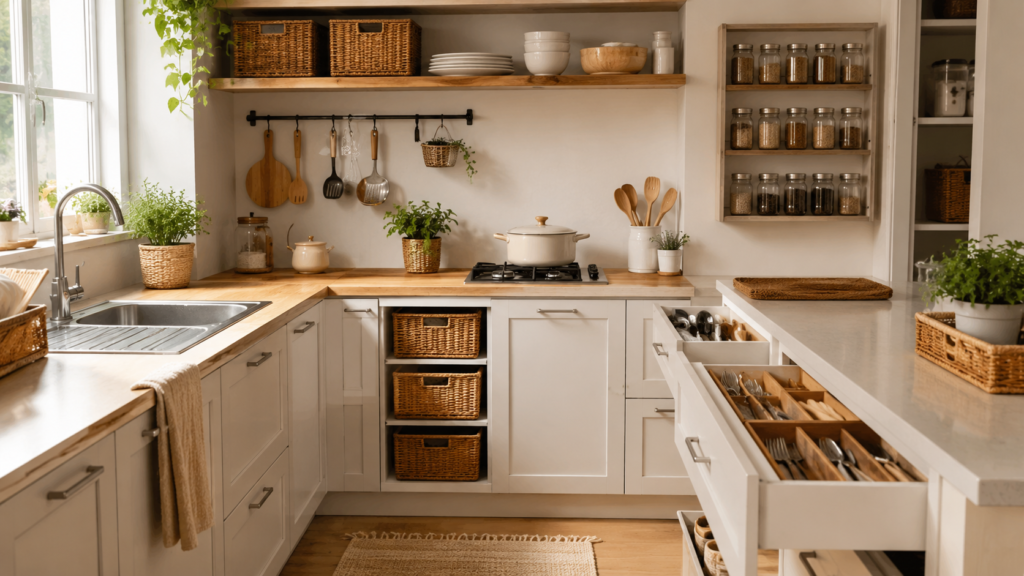
A small kitchen doesn’t necessarily need more cabinets.
Sometimes it simply needs a better system.
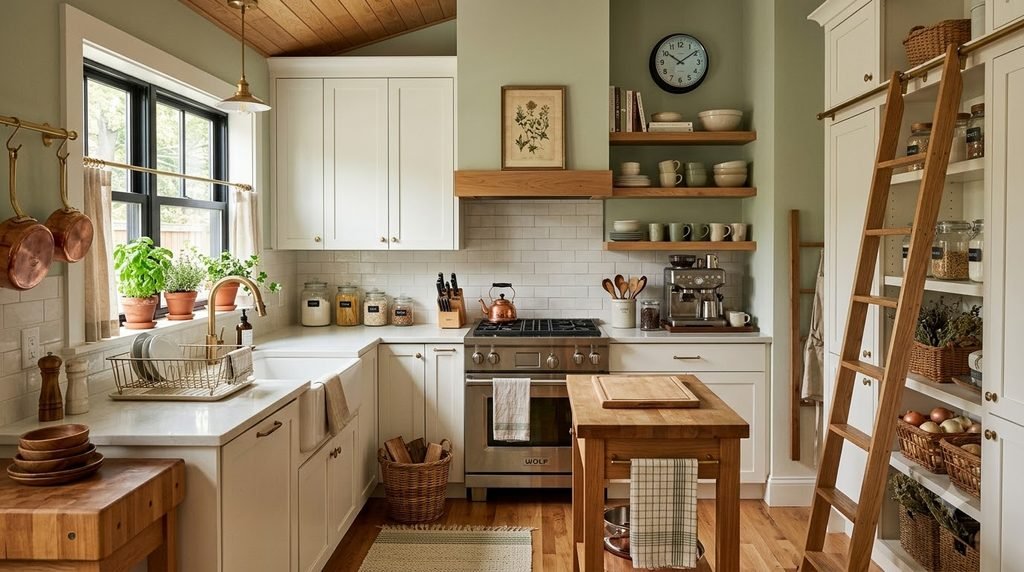
When counter space is limited and every cabinet seems full, it’s easy to assume that the only solution is a bigger kitchen. But many small kitchens have usable storage hiding in places we tend to overlook: the inside of cabinet doors, the vertical space above shelves, narrow gaps beside appliances, awkward corners, and even the area above the refrigerator.
The trick is to make those spaces work without making the kitchen harder to use.
Current 2026 kitchen-organization guidance is increasingly focused on practical storage, designated zones, vertical organization, drawer systems, and reducing the amount of unnecessary stuff taking up prime kitchen space.
If you’re working with a compact kitchen, apartment kitchen, galley kitchen, or simply a kitchen that always seems short on storage, these 21 small kitchen organization ideas can help you make better use of the space you already have.
How to Organize a Small Kitchen
Before buying organizers, take a quick look at how your kitchen currently works.
Ask yourself:
- What is always sitting on the counter?
- Which cabinets are difficult to use?
- What do I reach for every day?
- Which items are rarely used?
- Where do things tend to pile up?
- Are there empty vertical spaces?
- Are cabinet doors being used?
- Are awkward corners doing anything useful?
Then organize around frequency and function.
Everyday items should be easiest to reach.
Occasional items can move higher or farther away.
And things you never use should probably leave the kitchen altogether.
21 Small Kitchen Organization Ideas
1. Declutter Before Adding More Storage
This is the first step because more storage won’t solve a clutter problem if the kitchen contains too many things.
Take everything out of one cabinet or drawer at a time and group similar items together.
Look for:
- Duplicate mugs
- Extra water bottles
- Unused gadgets
- Broken utensils
- Expired food
- Appliances you rarely use
- Items that belong somewhere else
Professional organizers commonly recommend taking inventory and removing unused or duplicate items before trying to reorganize the kitchen.
You may discover that you already have enough storage—you just don’t have enough usable storage.
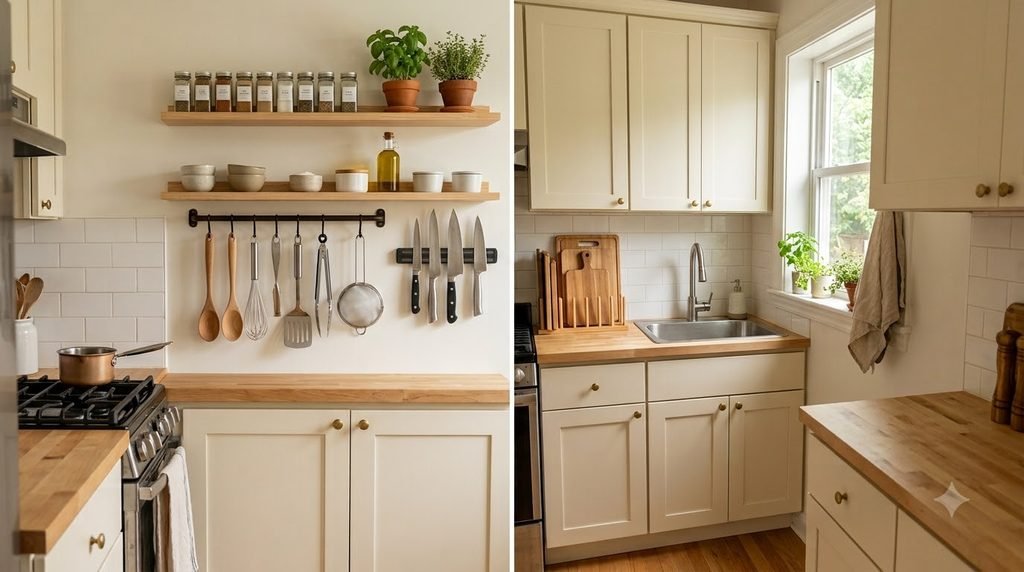
2. Turn Vertical Space Into Storage
When floor and counter space are limited, look upward.
The wall space between your counter and upper cabinets can hold:
- Hooks
- Rails
- Small shelves
- Magnetic organizers
- Lightweight baskets
- Frequently used utensils
You can also make better use of the full height inside cabinets with shelf risers.
Vertical storage is one of the most useful strategies for compact kitchens because it adds organization without taking additional floor space.
3. Add Shelf Risers Inside Cabinets
A cabinet shelf may have several inches of unused space above your dishes.
Instead of stacking everything into one tall pile, use a shelf riser to create another level.
This works particularly well for:
- Plates
- Bowls
- Mugs
- Canned goods
- Small pantry containers
The goal isn’t to squeeze as many things as possible into the cabinet.
The goal is to make each level visible and accessible.
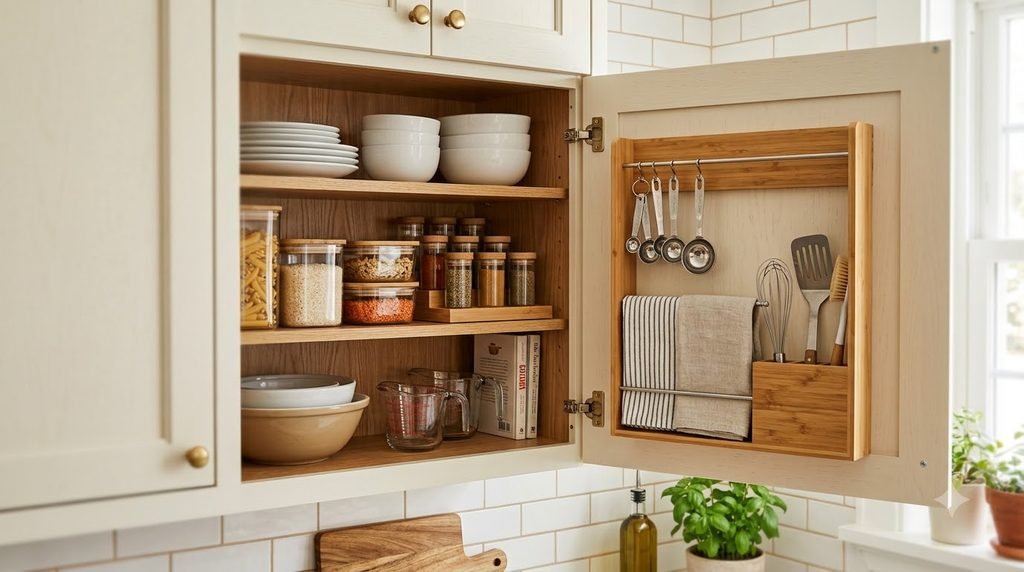
4. Use the Inside of Cabinet Doors
The inside of a cabinet door is often completely wasted.
Depending on the cabinet and available clearance, shallow organizers or hooks can hold:
- Measuring spoons
- Kitchen towels
- Small utensils
- Food wraps
- Cleaning cloths
- Lightweight accessories
Before installing anything, make sure the door can close properly without hitting shelves or stored items.
This is particularly useful in small kitchens because the storage is created without taking away counter or floor space.
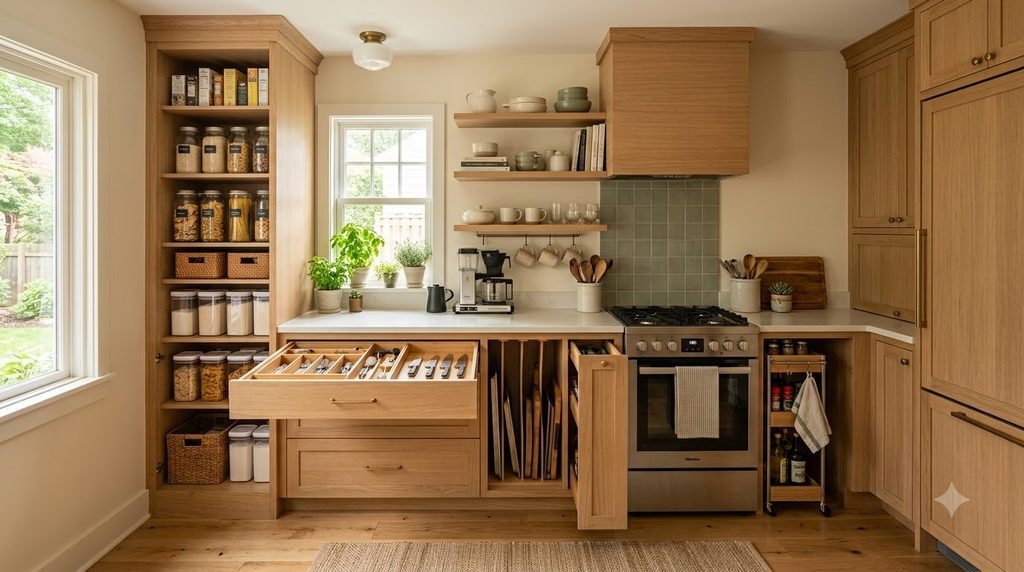
5. Store Baking Sheets and Cutting Boards Vertically
Large flat items are awkward when stacked horizontally.
Baking sheets, cutting boards, serving trays, and cooling racks can often be easier to access when stored vertically.
Use a divider or suitable organizer to keep them separated.
Then instead of lifting five pans to reach the one you want, you can simply pull out the correct item.
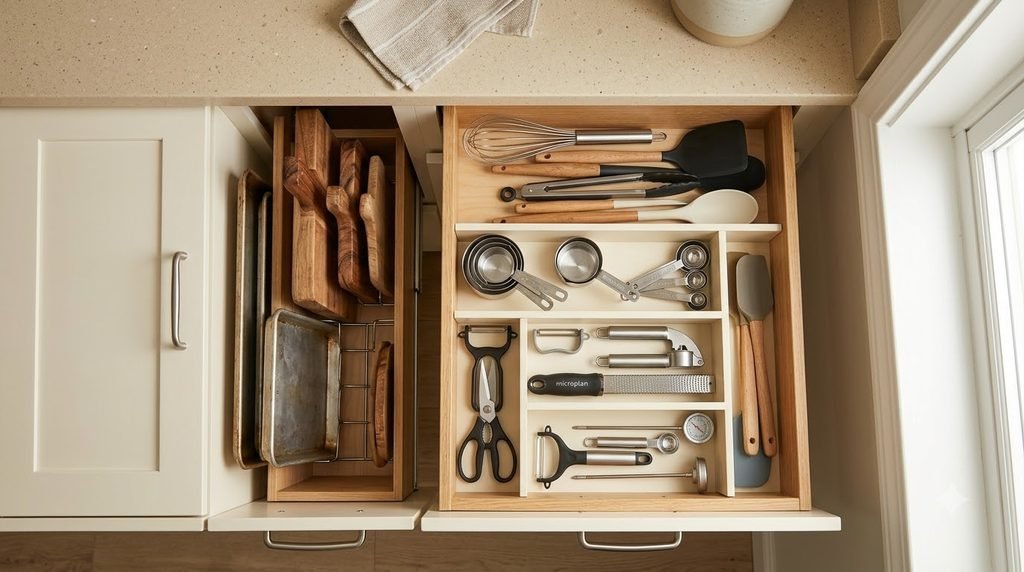
6. Give Your Drawers a Purpose
A kitchen drawer shouldn’t become a miscellaneous storage box.
Assign each drawer a function.
For example:
Drawer 1: everyday utensils
Drawer 2: cooking tools
Drawer 3: food-preparation accessories
Drawer 4: kitchen linens
Then use dividers where necessary to keep categories from mixing.
Adjustable dividers can be particularly useful because they allow the storage configuration to change as your needs change.
7. Create a Daily-Use Zone
Think about the five to ten things you use constantly.
Maybe it’s:
- Coffee supplies
- Favorite mugs
- Cooking utensils
- Cutting board
- Everyday plates
- Olive oil
- Salt and pepper
Keep these items together and within easy reach.
This reduces unnecessary movement around the kitchen and makes everyday routines faster.
Designated functional zones are a recurring recommendation in current kitchen-organization guidance.
8. Clear Your Countertops
Countertop clutter makes a small kitchen feel even smaller.
Look at everything currently sitting out.
Ask:
Do I use this every day?
If not, consider moving it into a cabinet, pantry, or storage area.
You don’t need completely empty counters.
A better goal is to keep only the items that genuinely earn their space.
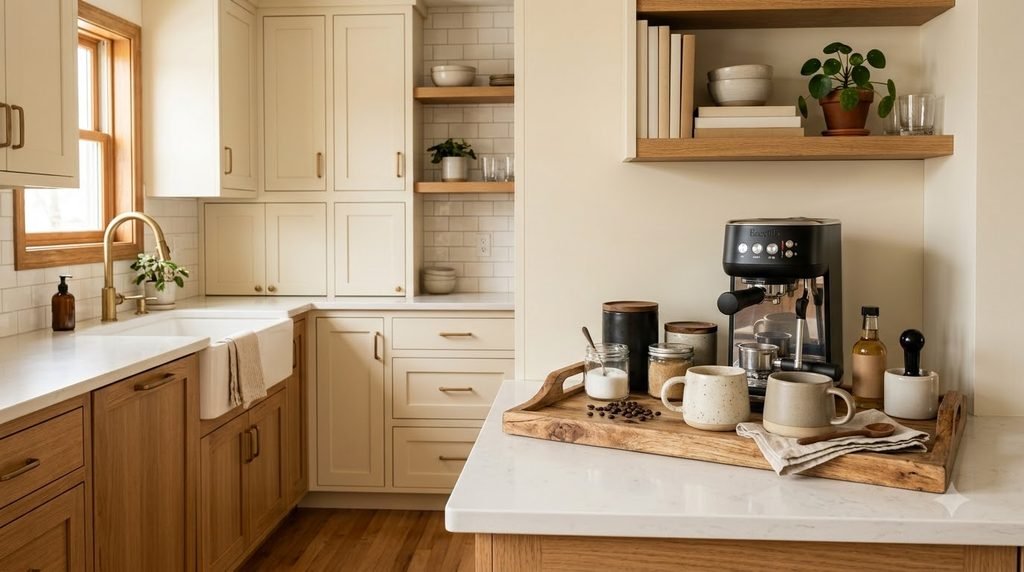
9. Create a Dedicated Coffee Station
If coffee is part of your daily routine, group everything together.
Depending on your available space, this could include:
- Coffee maker
- Mugs
- Coffee
- Filters
- Spoons
- Sweeteners
A tray can visually define the zone without requiring additional cabinetry.
If counter space is extremely limited, keep only the coffee maker visible and store the rest nearby.
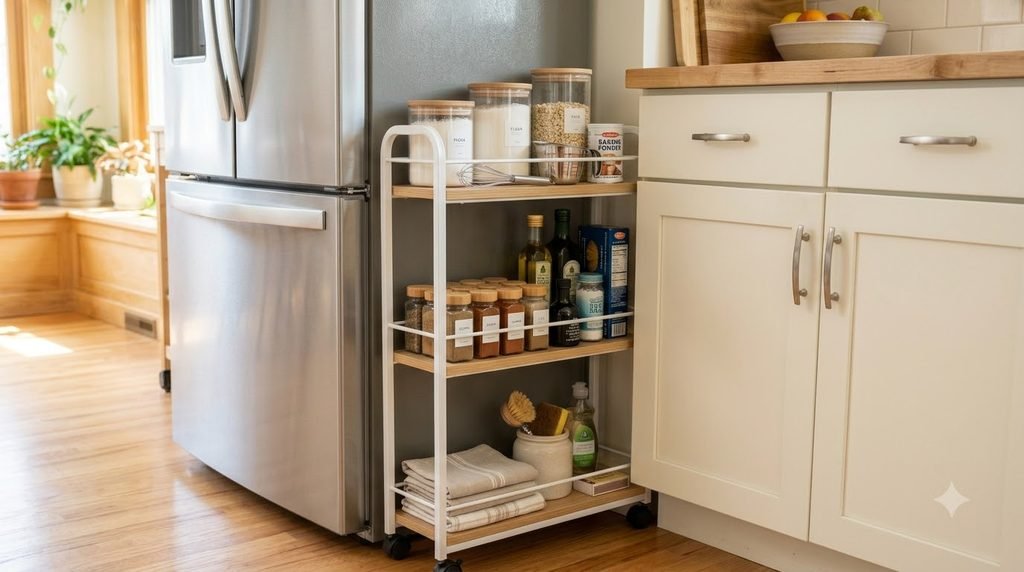
10. Use a Slim Rolling Cart
A narrow rolling cart can turn a small unused gap into useful storage.
Good locations include:
- Beside the refrigerator
- Between cabinets
- Beside a pantry
- At the end of a counter
Use the levels for:
- Pantry overflow
- Baking supplies
- Cleaning products
- Produce
- Coffee supplies
Because the cart can move, it can also become temporary workspace when needed.
Current 2026 small-kitchen coverage specifically highlights slim rolling carts as useful solutions for narrow spaces.
11. Make the Space Above the Refrigerator Useful
The area above the refrigerator is often forgotten.
If there is enough clearance and the items are lightweight, use a basket or suitable storage container for things you don’t need every day.
Good candidates include:
- Extra serving pieces
- Seasonal kitchen items
- Infrequently used accessories
- Backup supplies
Avoid storing heavy objects overhead where they could be difficult or unsafe to retrieve.
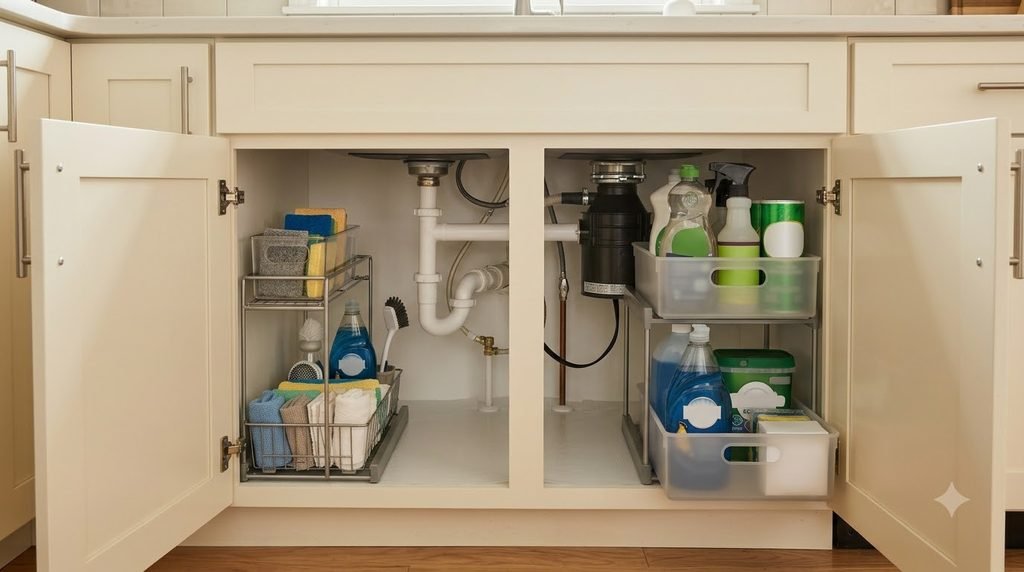
12. Organize Under the Sink
The cabinet underneath the sink can become one of the messiest areas in a small kitchen.
Start by removing everything.
Then group:
- Dishwashing supplies
- Cleaning cloths
- Sponges
- Trash bags
- Backup cleaning products
Use bins or small containers to separate categories.
Keep the products you use most frequently toward the front.
And always account for the plumbing when choosing organizers.
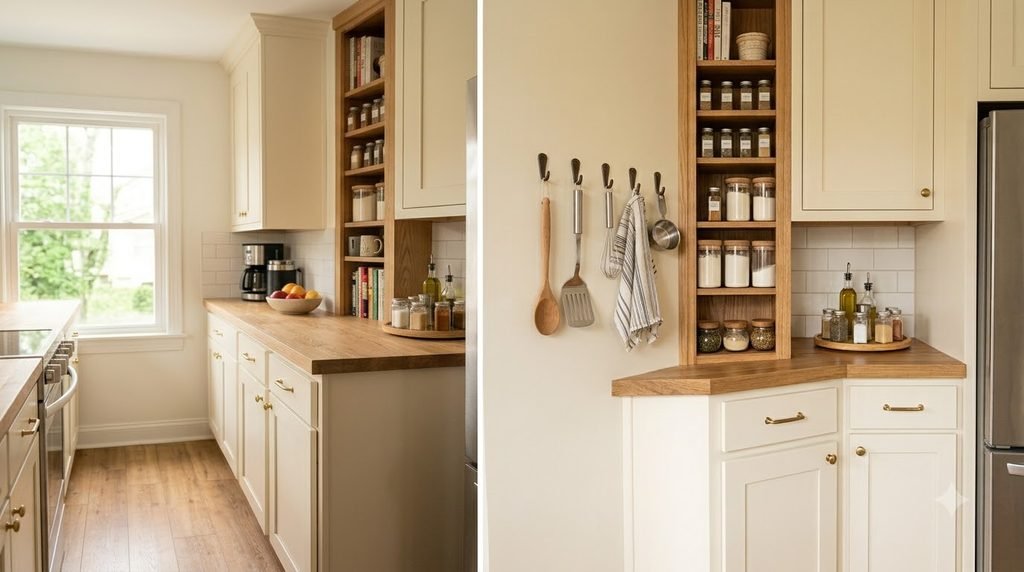
13. Use Awkward Corners
A kitchen corner doesn’t have to become dead space.
Depending on your layout, consider:
- A corner shelf
- Lazy Susan
- Narrow basket
- Rolling cart
- Corner drawer
- Vertical storage
The important thing is to choose a solution that allows you to reach everything without unloading the entire corner.
14. Give Spices a Dedicated Home
Spices tend to become difficult to manage because they’re small and numerous.
Instead of spreading them across multiple cabinets, create one designated zone.
Options include:
- A shallow drawer
- Tiered shelf
- Small basket
- Turntable
- Dedicated cabinet section
Arrange the spices so labels are visible.
If you cook frequently, placing your most-used spices closest to the preparation area can make cooking more efficient.
15. Store Pots and Pans by Frequency
Heavy cookware can consume a surprising amount of cabinet space.
Start by identifying what you actually use.
Keep everyday pots and pans easiest to reach.
Move specialty cookware higher or farther away.
If your cookware nests safely, stack compatible pieces together.
For lids, vertical organization can prevent the familiar problem of digging through a pile every time you need one.
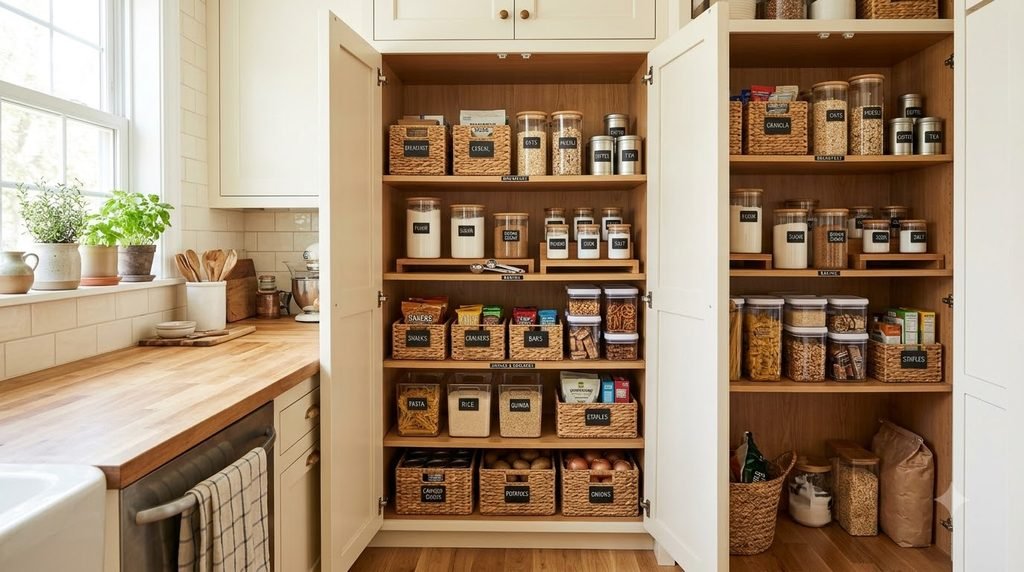
16. Create a Small Pantry Zone—Even Without a Pantry
You don’t need a walk-in pantry to have organized pantry storage.
Choose one cabinet, shelf, or rolling cart and turn it into a dedicated dry-food zone.
Group items by category:
Breakfast
Baking
Snacks
Canned goods
Cooking staples
This keeps food from spreading into every available cabinet.
17. Move Rarely Used Appliances Out of Prime Space
Small kitchens often lose valuable storage to appliances that are used only occasionally.
Think about:
- Specialty mixers
- Ice cream makers
- Fondue sets
- Large serving appliances
- Seasonal equipment
If you use something only a few times a year, it doesn’t necessarily need the easiest-to-reach cabinet.
Move occasional-use appliances to:
- Higher shelves
- A utility cabinet
- Garage storage
- Basement storage
- Another suitable area
This frees prime kitchen space for things you actually use.
18. Use the Side of a Cabinet
The side panel of a cabinet can sometimes become useful vertical storage.
Depending on the location, you could add:
- Hooks
- Rails
- A shallow organizer
- Magnetic storage
This can work particularly well beside a refrigerator or at the end of a cabinet run.
Just make sure the installation doesn’t interfere with doors, walkways, or appliance ventilation.
19. Create a Small Cleaning Station
Instead of scattering dish soap, sponges, brushes, and cleaning cloths around the sink, give them one defined area.
A small tray or container can keep the essentials together.
You can also use the cabinet beneath the sink for backup supplies.
The result is a cleaner countertop and an easier cleanup routine.
20. Use One “Kitchen Drop Zone”
Every kitchen tends to accumulate random items.
Mail.
Receipts.
Keys.
Reusable bags.
School papers.
Small household objects.
If your kitchen is the natural drop zone in your home, don’t pretend it won’t happen.
Instead, give those items a controlled landing place.
A small tray, basket, or drawer can keep temporary clutter contained.
Then empty it regularly.
21. Make Organization Match Your Cooking Habits
This is the step that ties everything together.
Don’t organize your kitchen according to how a storage catalog says you should.
Organize it according to how you actually cook and move through the space.
If you make coffee every morning, coffee supplies should be easy to reach.
If you bake every weekend, baking supplies deserve a convenient zone.
If you rarely use formal dinnerware, it can go somewhere less accessible.
Your kitchen should support your routines—not force you to change them.
Small Kitchen Organization Ideas for Apartments
Apartment kitchens often have limited cabinets and little room for additional furniture.
Focus on solutions that don’t consume valuable floor space.
Try:
- Shelf risers
- Door organizers
- Wall hooks
- Slim rolling carts
- Drawer dividers
- Stackable containers
- Vertical cookware storage
- Multipurpose storage
And before buying anything large, measure the available space carefully.
A storage solution is only useful if you can still comfortably open doors, move around the kitchen, and access your appliances.
How to Organize a Small Kitchen With No Pantry
No pantry doesn’t mean you can’t have pantry-style organization.
Choose one cabinet, shelf, or slim cart as your pantry zone.
Then group dry goods by category and keep the items you use most frequently at eye level.
You can also use:
- Shelf risers
- Door organizers
- Pull-out bins
- Narrow carts
- Stackable containers
The key is creating one predictable location for food storage rather than spreading pantry items throughout the kitchen.
How to Make a Small Kitchen Feel Bigger
Organization can change how spacious a kitchen feels.
Keep counters visually clear
Less visible clutter creates more breathing room.
Use vertical storage
Shelves and wall storage draw the eye upward.
Keep colors cohesive
A consistent palette can make the room feel calmer.
Avoid oversized organizers
An organizer that consumes half your cabinet isn’t necessarily helping.
Store bulky items strategically
Move infrequently used appliances away from the easiest-to-reach areas.
Leave some empty space
You don’t have to fill every shelf.
A little breathing room makes a kitchen easier to use and maintain.
Small Kitchen Organization Mistakes to Avoid
Buying Organizers Before Decluttering
You may end up creating storage for things you don’t actually need.
Filling Every Empty Space
Just because a space can hold something doesn’t mean it should.
Ignoring Workflow
If the cutting board is across the room from the prep area, organization won’t feel efficient.
Keeping Everything at Eye Level
Reserve convenient storage for the things you use most.
Creating Complicated Systems
If putting something away requires three steps, you may eventually stop doing it.
Forgetting Measurements
Always measure cabinets, drawers, gaps, and door clearances before buying storage accessories.
Frequently Asked Questions
How do I organize a very small kitchen?
Start by decluttering, then prioritize vertical storage, cabinet-door storage, shelf risers, drawer dividers, slim rolling carts, and designated zones for everyday items.
How can I get more storage in a small kitchen?
Use space that is currently underutilized, such as cabinet interiors, cabinet doors, vertical walls, narrow gaps, corners, and the space above the refrigerator.
How do I organize a small kitchen without a pantry?
Choose one cabinet, shelf, or rolling cart as a dedicated pantry zone. Group dry goods by category and use shelf risers or stackable storage to make better use of vertical space.
Where should I store appliances in a small kitchen?
Keep frequently used appliances accessible. Move specialty or rarely used appliances to higher shelves or another suitable storage area so prime cabinet space remains available for everyday items.
How do I keep a small kitchen counter clutter-free?
Keep only genuinely everyday items on the counter. Give everything else a designated cabinet, drawer, pantry, or storage zone.
What is the best storage solution for a tiny kitchen?
There isn’t one universal solution. The most effective approach is usually a combination of decluttering, vertical storage, better cabinet interiors, designated zones, and storage that matches your cooking habits.
Final Thoughts
A small kitchen doesn’t need to feel like a storage puzzle every time you cook.
The biggest improvement often comes from changing where things live, not buying more things.
Start by removing what you don’t use.
Then look upward.
Use cabinet doors.
Divide drawers.
Give everyday items convenient homes.
Turn awkward gaps into useful storage.
Move rarely used appliances away from prime space.
And most importantly, organize the kitchen around your actual routines.
You don’t need to make every cabinet perfectly organized.
You just need to make the kitchen easier to use tomorrow than it was today.
That’s what makes a small kitchen feel bigger—and much more functional.