A crowded closet can make even a simple morning routine feel harder than it needs to be. Clothes become difficult to find, shoes end up on the floor, and folded items quickly turn into messy piles.

The good news is that you don’t necessarily need a bigger closet to create more usable storage.
With the right combination of decluttering, vertical storage, shelf organization, and simple everyday systems, you can make a small or crowded closet feel much more functional.
If you’re looking for closet organization ideas that work in real homes, these 15 practical solutions can help you maximize the space you already have.
1. Start by Decluttering Your Closet
Before buying organizers, baskets, or additional shelves, reduce the amount of clothing and accessories you actually need to store.
Take everything out in manageable sections and sort items into:
- Keep
- Donate
- Repair
- Seasonal storage
- Unsure
Pay particular attention to clothes you haven’t worn in a long time, uncomfortable pieces, duplicates, damaged items, and things that no longer fit your current lifestyle.
Once you remove what you don’t need, you’ll have a much clearer idea of what your closet actually needs.
This also helps prevent a common organization mistake: buying storage products before understanding the problem.
If you’re unsure where to start, work category by category rather than emptying the entire closet at once.
For additional decluttering and organization ideas throughout your home, see our 10 simple home organization ideas that make everyday life easier.

2. Switch to Slim Matching Hangers
Bulky hangers can quickly consume valuable closet rod space.
Slim matching hangers create a more consistent look and can give you additional room for clothing without changing the size of the closet.
Start with the most crowded section rather than replacing every hanger at once.
Use the same hanger style for similar clothing when practical, and leave a little space between categories so you can easily see what you own.
Matching hangers are not a substitute for decluttering, but they can make an already-organized closet easier to maintain.
If your closet is extremely crowded, combine slim hangers with a second hanging level or another vertical storage solution.
3. Use a Double-Hanging Rod
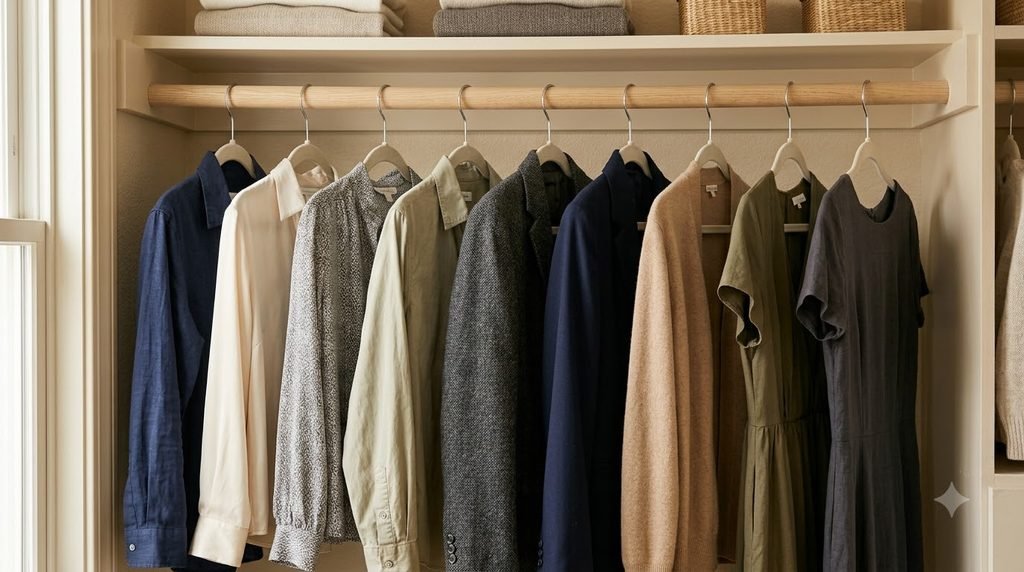
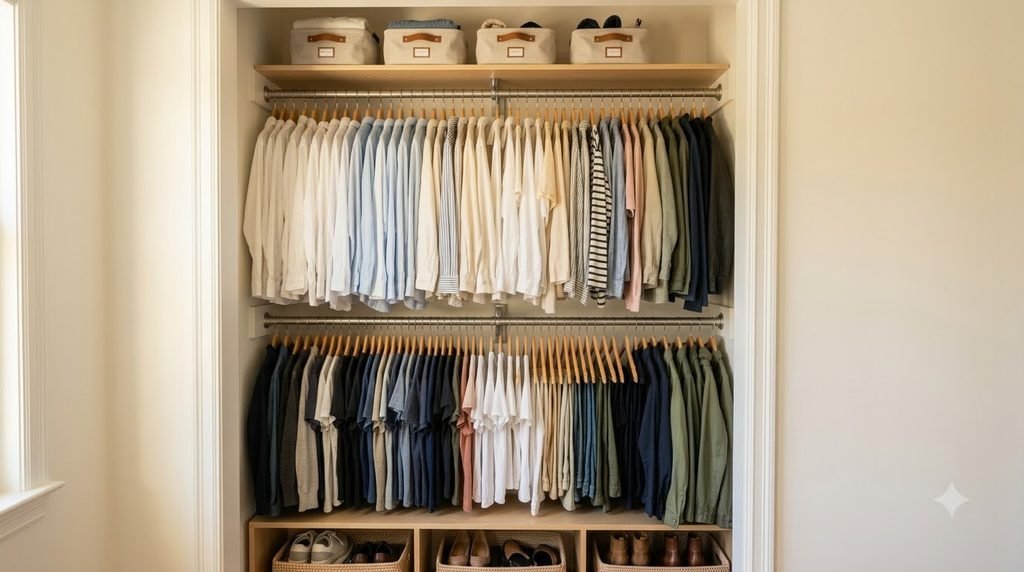
If there is unused vertical space below your existing clothing rod, a second hanging level can significantly improve the way you use a small closet.
A double-hanging rod works particularly well for shorter clothing such as:
- Shirts
- Blouses
- Skirts
- Folded-length pants
- Children’s clothing
Keep the clothing you wear most often at the easiest height to reach.
Before installing a second rod, make sure there is enough vertical clearance for the clothes to hang without interfering with shelves, drawers, doors, or other storage.
This is especially useful in a small reach-in closet where expanding the floor area isn’t possible.
For a more detailed fall-specific closet reset, see our
How to Organize Your Closet for Fall in 15 Easy Steps.
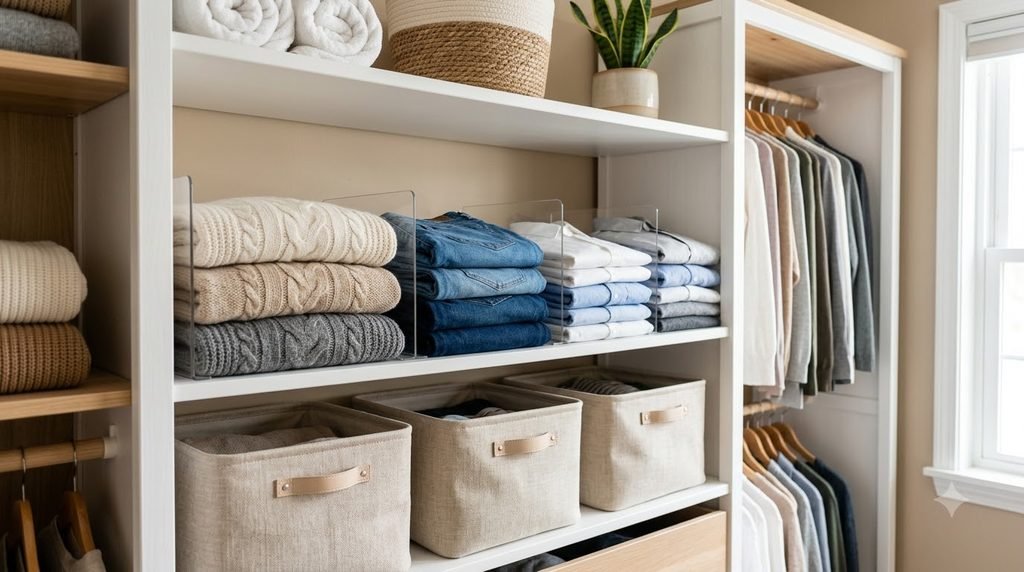
4. Add Shelf Dividers
Folded sweaters, jeans, shirts, and handbags can quickly become unstable piles.
Shelf dividers create boundaries between different stacks and make it easier to keep everything upright.
You can use them to separate:
- Sweaters
- Jeans
- Handbags
- Towels
- Hats
- Folded shirts
Instead of one large pile, each category gets its own defined section.
This simple change can make shelves easier to maintain and easier to see.
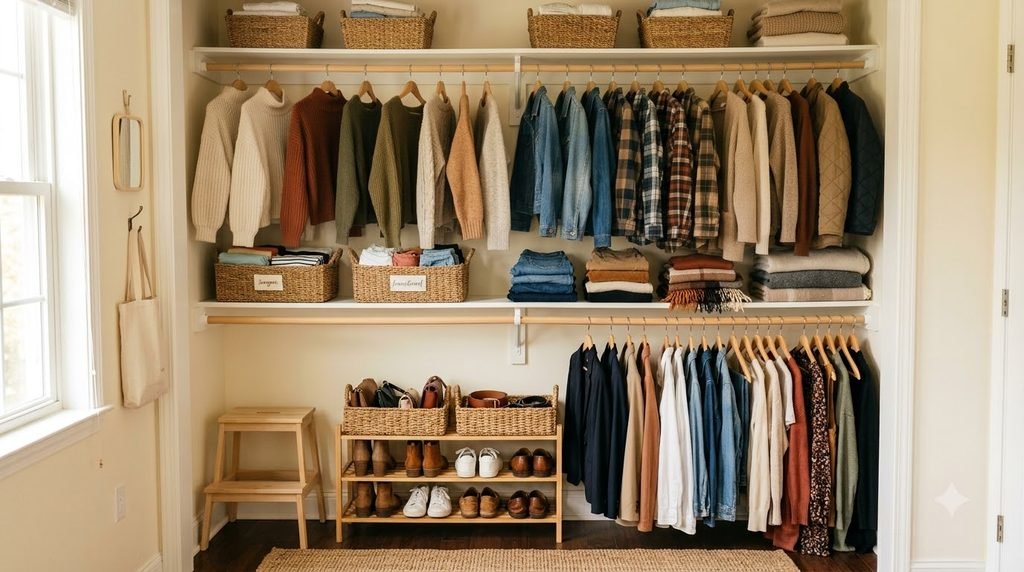
5. Use the Top Shelf for Seasonal Items
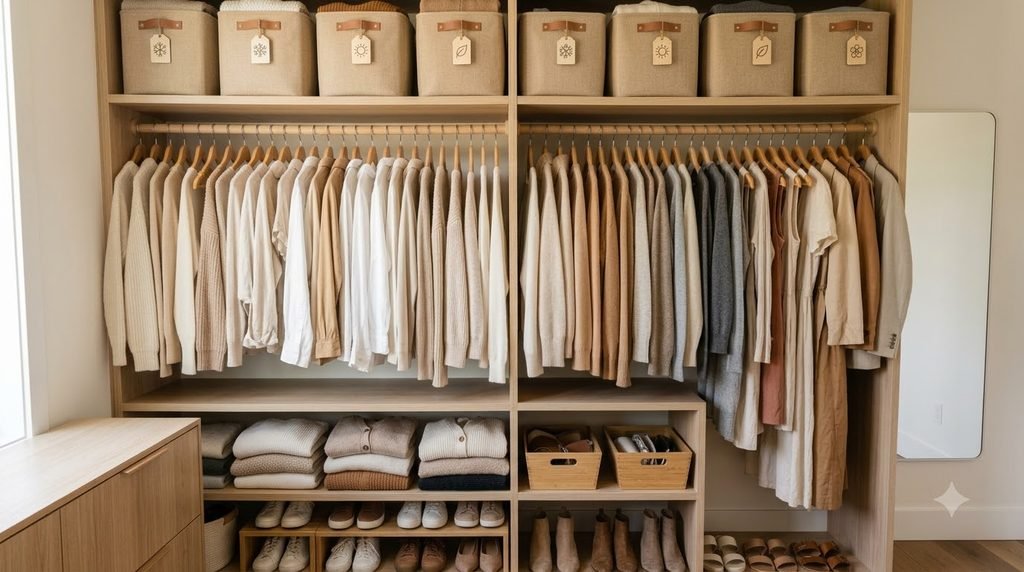
The highest shelf in your closet is often difficult to access, which makes it a good location for things you don’t need every day.
Use labeled bins or baskets for:
- Winter accessories
- Heavy sweaters
- Holiday clothing
- Extra blankets
- Off-season shoes
- Seasonal accessories
Keep everyday clothing at easier-to-reach levels and reserve the upper shelf for items you only need occasionally.
Avoid storing anything excessively heavy or difficult to safely retrieve.
If you’re preparing your wardrobe for a seasonal change, you can also use this opportunity to rotate clothing instead of keeping your entire wardrobe equally accessible throughout the year.
6. Make Better Use of the Closet Door
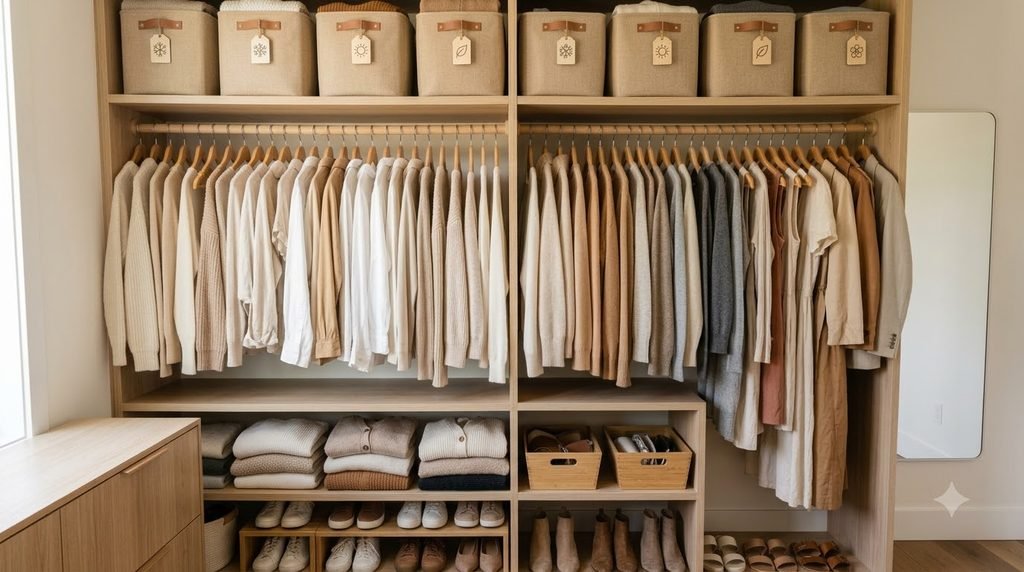
The back of a closet door can provide useful storage without taking up additional floor space.
Depending on the door and available clearance, consider an over-the-door organizer for:
- Shoes
- Scarves
- Belts
- Handbags
- Hair accessories
- Small clothing accessories
Before installing one, make sure it doesn’t prevent the door from closing properly or interfere with shelves and hanging clothes.
For a small bedroom closet, door storage can be especially useful because it turns an otherwise overlooked surface into an additional storage zone.
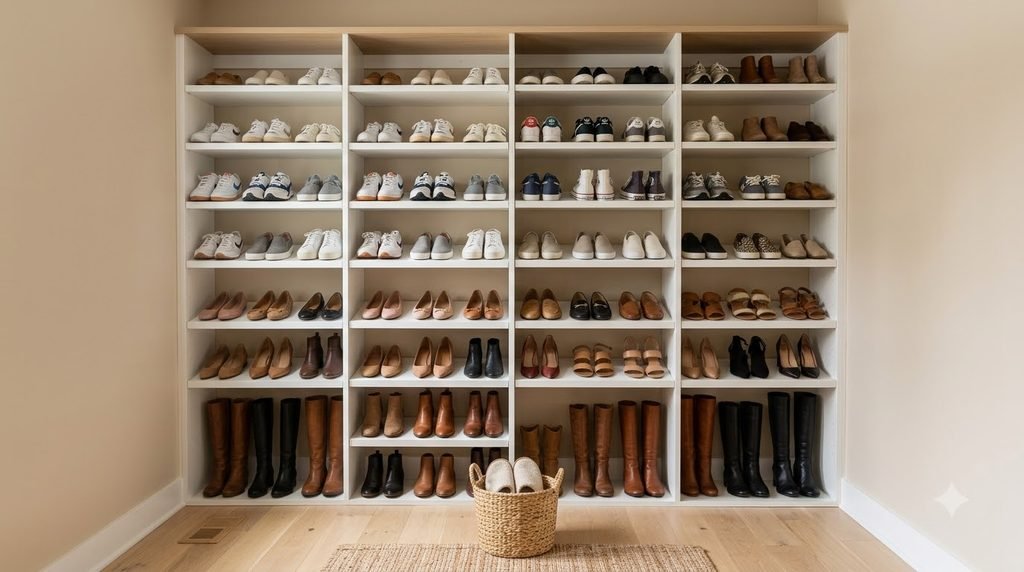
7. Organize Shoes Vertically
Shoes can quickly take over the floor of a small closet.
Instead of keeping every pair in a loose row, use vertical storage such as:
- Tiered shoe racks
- Shoe shelves
- Hanging shoe organizers
- Stackable shoe boxes
Keep frequently worn shoes at an easy-to-reach height.
Less frequently worn or seasonal footwear can be stored higher or toward the back.
If you have limited closet floor space, prioritize vertical shoe storage before adding another large floor-standing organizer.
For other ways to make a compact home work harder, see our small space organization ideas.
8. Use Matching Storage Bins
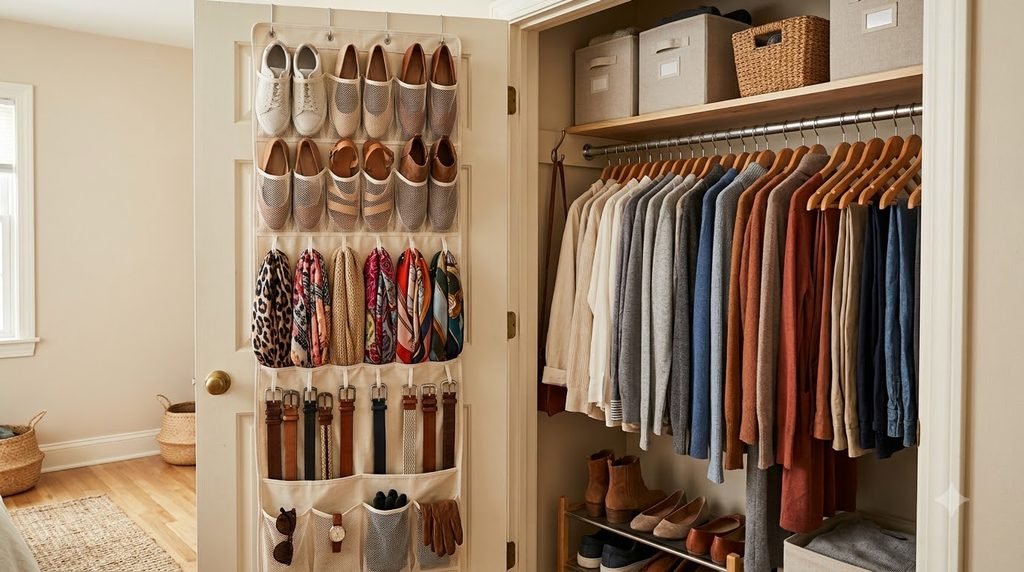
Storage bins are useful for items that don’t need to hang.
Choose a few matching bins for accessories and less frequently used clothing.
You could create separate bins for:
- Handbags
- Scarves
- Belts
- Seasonal accessories
- Swimwear
- Small personal items
Labeling each bin can make it easier to find things without opening every container.
Don’t overfill them. A storage bin works best when you can easily see or access what’s inside.
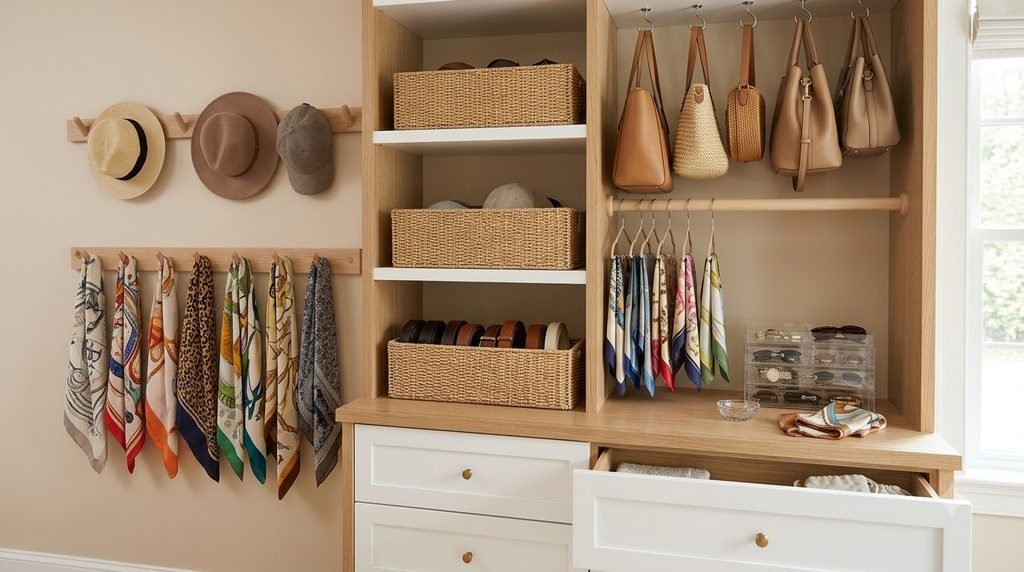
9. Create a Dedicated Accessories Zone
Small accessories tend to become scattered throughout a closet.
Instead of keeping belts, scarves, hats, and bags wherever there happens to be room, create one dedicated accessories zone.
Hooks, small baskets, drawer dividers, and hanging organizers can help keep these items together.
For example, use one section for bags and another for scarves and belts.
A designated zone means you’re less likely to lose smaller items inside larger piles.
10. Use Vertical Space Above and Below
One of the easiest ways to increase storage in a small closet is to use the space that normally goes unused.
Look above the clothing rod, below hanging clothes, between shelves, and in the gaps around existing storage.
Depending on your closet layout, you may be able to add:
- Stackable bins
- Extra shelves
- Shoe racks
- Hanging organizers
- Small baskets
- Under-shelf baskets
- Narrow storage units
Don’t try to fill every available inch.
Leave enough open space to see and reach your belongings comfortably.
The goal is to create usable storage, not simply more storage.
11. Fold Clothes That Don’t Need to Hang
Not every piece of clothing needs a hanger.
T-shirts, workout clothes, sweaters, pajamas, and some casual pants can often be folded and stored on shelves or inside drawers.
Moving appropriate clothing from hanging storage to folded storage can free up valuable rod space.
Try storing folded clothes vertically inside drawers when practical so you can see more of your wardrobe without digging through a stack.
12. Create a Simple Laundry Basket Zone
If your closet or bedroom has enough space, give dirty clothes a designated home.
A laundry basket placed near the closet can prevent clothing from ending up on the floor.
For a shared bedroom or family closet, you could use separate compartments for different laundry categories.
Choose a basket that fits naturally into the available space rather than one that blocks drawers or doors.
13. Use a Small Donation Basket
One of the easiest ways to prevent closet clutter from returning is to create a permanent donation spot.
Keep a small basket or reusable bag somewhere accessible.
Whenever you come across something you no longer want, place it directly into the donation container.
Once it becomes full, take it to a local donation center.
This creates an ongoing decluttering habit instead of requiring a huge closet cleanout every few months.
14. Organize Your Closet by Frequency of Use
A closet becomes easier to maintain when the things you use most are also the easiest to reach.
Keep frequently worn clothing in the most accessible areas.
Move special-occasion outfits, seasonal clothing, and rarely used accessories to higher shelves, less accessible sections, or separate storage.
You can organize your everyday clothing by:
- Everyday tops
- Work clothes
- Casual clothes
- Dresses
- Jackets
- Pants
- Workout clothes
You can add color-coding afterward if it genuinely helps you find things faster.
Function should come before appearance.
The best closet organization system is the one that matches the way you actually get dressed and use your wardrobe.
15. Do a 15-Minute Closet Reset Every Week
A closet doesn’t stay organized simply because you organized it once.
A short weekly reset can prevent small problems from turning into a major cleanout.
Set aside about 15 minutes to:
- Return misplaced clothing.
- Put shoes back in their designated area.
- Refold messy stacks.
- Remove empty hangers.
- Move seasonal items when necessary.
- Add unwanted items to your donation basket.
- Check whether any storage zone has become overcrowded.
If something repeatedly ends up in the wrong place, don’t simply put it away again.
Ask whether the storage location is actually convenient.
Sometimes the best organization improvement is moving an item closer to where you naturally use it.
16. Small Walk-In Closet Organization Ideas
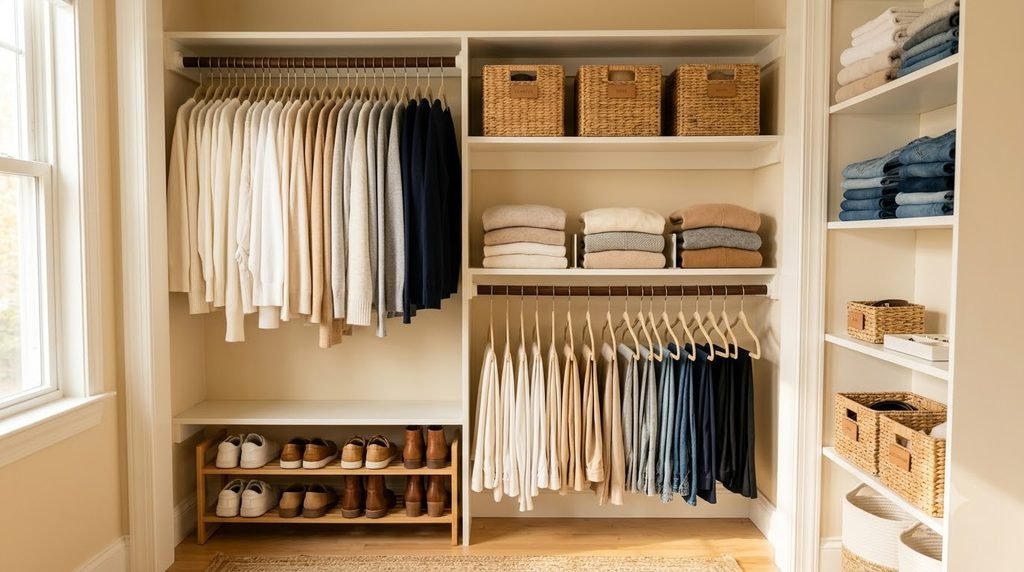
A walk-in closet may have more space than a reach-in closet, but that doesn’t automatically make it easy to organize.
The biggest mistake is allowing every available area to become storage.
Start by creating clear zones for:
- Hanging clothes
- Folded clothing
- Shoes
- Accessories
- Seasonal items
- Frequently used clothing
Keep everyday items in the easiest-to-reach sections and reserve higher shelves or less accessible corners for seasonal and occasional items.
If you have open floor space, resist the temptation to fill it with unnecessary furniture.
A small walk-in closet usually works better when the center remains open and the storage stays organized around the perimeter.
17. Small Reach-In Closet Organization Ideas
Reach-in closets require a different approach because depth and floor space are usually limited.
Focus on making the existing wall-to-wall space work harder.
Try combining:
- Slim matching hangers
- A double-hanging rod
- Shelf dividers
- Vertical shoe storage
- Over-the-door organizers
- Stackable bins
- Under-shelf baskets
Keep the most frequently worn clothing toward the center or easiest-to-reach section.
Use the upper shelf for seasonal items and the lower area for shoes or other everyday accessories.
If the closet is extremely narrow, avoid deep storage containers that make the space difficult to access.
18. Closet Organization Ideas Without a Dresser
You don’t necessarily need a dresser inside your bedroom to organize folded clothing.
If your closet has shelves, use them strategically for items such as:
- T-shirts
- Jeans
- Workout clothing
- Pajamas
- Sweaters
- Towels
Shelf dividers can keep stacks from falling over, while small bins can contain underwear, accessories, or other smaller items.
You can also use vertical folding techniques inside drawers or bins when practical so that more of your clothing remains visible.
The goal is to make the closet perform multiple storage functions rather than relying on one piece of furniture for everything.
19. How to Organize a Closet With Too Many Clothes
If your closet feels full even after adding organizers, the problem may be the amount of clothing rather than the storage system.
Start by removing obvious duplicates, damaged pieces, uncomfortable clothing, and items you haven’t worn in a long time.
Then divide the remaining wardrobe into:
Frequently worn:
Keep these in the easiest-to-reach locations.
Occasionally worn:
Store nearby but outside the prime everyday zone.
Seasonal:
Move to upper shelves, labeled bins, or another storage area.
Unsure:
Set aside temporarily and review later rather than immediately returning everything to the closet.
This approach allows you to create more usable space without immediately buying more storage.
20. Closet Storage Ideas for Small Bedrooms
When both the bedroom and closet are small, avoid solving a storage problem by adding more bulky furniture.
Instead, make better use of existing areas.
Consider:
- Over-the-door organizers
- Slim baskets
- Vertical shoe racks
- Narrow storage units
- Under-bed storage
- Wall hooks
- Shelf dividers
- Double-hanging rods
Keep the bedroom floor as open as possible.
If something can be stored inside the closet or under the bed without making it difficult to access, that may be preferable to adding another large piece of furniture.
For more ideas, see our small space organization ideas.
21. Closet Organization Ideas for Couples Sharing a Closet
Sharing a closet can become much easier when each person has clearly defined storage areas.
Instead of mixing everything together, divide the closet into practical zones.
For example:
Person 1: left hanging section + upper shelf
Person 2: right hanging section + upper shelf
Shared: shoes, accessories, or seasonal storage
If one person has more hanging clothing and the other needs more folded storage, don’t force an equal split.
The goal is to divide the space according to actual storage needs.
Clear zones also make it easier to put clothing away without creating a mixed pile.
22. Renter-Friendly Closet Organization Ideas
You can improve a rental closet without making permanent changes.
Depending on the closet and product specifications, consider:
- Over-the-door organizers
- Freestanding shoe racks
- Removable hooks where appropriate
- Stackable storage bins
- Freestanding shelves
- Hanging organizers
- Fabric storage cubes
- Tension-based solutions where suitable
Before installing anything permanently, check your lease and follow the manufacturer’s instructions.
A renter-friendly system should be easy to adjust, remove, and take with you when you move.
23. How to Organize Closet Shelves
Closet shelves work best when different categories have clearly defined areas.
Instead of creating one large stack of clothing, divide the shelf into sections.
For example:
- Sweaters
- Jeans
- T-shirts
- Handbags
- Accessories
- Seasonal items
Use shelf dividers to prevent stacks from leaning into each other.
For smaller items, use appropriately sized baskets or bins.
Avoid packing shelves so tightly that you have to pull everything out to reach one item.
Leave a little breathing room so the shelf remains easy to use and reset.
24. How to Organize a Closet on a Budget
You don’t need an expensive custom closet system to improve your storage.
Start with free or inexpensive changes:
- Declutter before buying anything
- Rearrange existing shelves
- Move seasonal items to higher storage
- Repurpose baskets you already own
- Use simple hooks
- Add inexpensive shelf dividers
- Use stackable bins
- Rotate clothing seasonally
Before buying a new organizer, identify the exact problem it is supposed to solve.
A $10 solution that fixes one specific storage problem can be more useful than an expensive system that adds unnecessary complexity.
25. Create an Everyday Clothing Zone
One useful way to make a closet easier to use is to create a dedicated everyday clothing section.
Keep the clothing you reach for most often together instead of spreading it across the entire closet.
Depending on your wardrobe, this could include:
- Everyday tops
- Favorite jeans
- Work basics
- Workout clothing
- Frequently worn dresses
- Comfortable casual clothing
Keep special-occasion clothing and seasonal items outside this prime zone.
This makes getting dressed faster and also reduces the amount of clothing you handle every day.
If an item hasn’t been worn for a long time, that may also be a useful signal to reconsider whether it deserves valuable everyday closet space.
26. Create a Simple Closet Maintenance Routine
A closet is easier to maintain when organization becomes part of your normal routine.
Once a week, spend a few minutes checking:
- Clothing that was left out
- Shoes that aren’t in their designated area
- Overcrowded shelves
- Empty hangers
- Items ready for donation
- Seasonal clothing that needs to be rotated
Once a month, take a slightly deeper look at one category instead of trying to reorganize the entire closet.
Small maintenance sessions are easier to sustain than waiting until the closet becomes completely overwhelming.
The goal is to make organization a habit rather than a once-a-year project.
How to Organize a Small Closet Without Remodeling
You don’t need a custom closet system to make a small closet more functional.
Start with the basics:
Declutter first.
Then identify the biggest problem.
If the clothing rod is crowded, improve your hanging system.
If shelves are messy, add dividers or bins.
If shoes are taking over the floor, use vertical shoe storage.
If accessories are scattered everywhere, create a dedicated zone.
This problem-first approach prevents you from buying storage products you don’t actually need.
Many current small-closet guides emphasize targeted improvements such as slim hangers, shelf dividers, stackable bins, and secondary hanging solutions rather than immediately installing an expensive custom system.
Closet Organization Ideas for Small Bedrooms
When your bedroom and closet are both small, avoid adding bulky furniture unless it solves a specific storage problem.
Instead, look for ways to use existing areas more efficiently.
Try:
- Under-bed storage
- Over-the-door organizers
- Slim baskets
- Vertical shoe racks
- Narrow dressers
- Wall hooks
- Shelf dividers
- Double hanging rods
Keeping the floor clear can also make a small bedroom feel noticeably more spacious.
How to Make Your Closet Look More Organized
Organization doesn’t have to be expensive to look good.
A few simple visual changes can make a big difference.
Use matching hangers where possible. Group similar clothing together. Choose a small number of coordinated baskets rather than mixing many different storage styles.
Leave some breathing room between categories instead of packing every shelf completely full.
A closet doesn’t need to look like a showroom.
It simply needs to be easy to see, easy to access, and easy to reset.
A Simple Seasonal Closet Reset
August is also a useful time to prepare your wardrobe for the transition into fall.
Start by removing clothing that no longer fits the current season.
Then:
Step 1: Pull Summer Items Forward
Keep lightweight pieces that you’ll still wear regularly within easy reach.
Step 2: Check Your Fall Clothing
Bring sweaters, jackets, jeans, and other fall layers back into accessible storage.
Step 3: Remove Worn-Out Pieces
Look for damaged, uncomfortable, or rarely worn clothing.
Step 4: Store True Seasonal Items
Move items you won’t need for several months into labeled bins or higher shelves.
Step 5: Leave Room for New Arrivals
Don’t fill every available inch.
Keeping a little open space makes the closet easier to maintain.
Seasonal wardrobe editing is particularly timely in August as summer begins transitioning toward fall layering.
Common Closet Organization Mistakes to Avoid
Even a well-organized closet can become cluttered again if the system is too complicated.
Avoid these common mistakes:
Buying Storage Before Decluttering
More bins won’t solve the problem if the closet contains too many items.
Using Every Inch
A completely packed closet is difficult to maintain.
Creating Too Many Categories
If every type of clothing has its own tiny section, putting things away can become unnecessarily complicated.
Storing Everyday Items Too High
Keep frequently used items within easy reach.
Choosing Storage That Doesn’t Fit
Measure your shelves, doors, and available floor space before buying organizers.
Final Thoughts
The best closet organization ideas don’t require a huge budget or a complete renovation.
Start by removing what you no longer need, then focus on the specific problems making your closet difficult to use.
Use slim hangers to create more hanging space, shelf dividers to control folded clothing, bins for seasonal items, vertical storage for shoes and accessories, and simple routines to keep everything in place.
Whether you have a tiny reach-in closet, a shared bedroom closet, or simply too many clothes for the space you have, small improvements can make a noticeable difference.
The goal isn’t to create a perfect closet.
It’s to create a closet where everything has a place, the things you use most are easy to reach, and putting things away doesn’t feel like a chore.
Related Jessica Millers Articles
For more practical home organization ideas, check out:
- 12 Small Space Organization Ideas to Make Your Home Feel Bigger
- 10 Simple Home Organization Ideas That Make Everyday Life Easier
- How to Organize Your Closet for Fall in 15 Easy Steps
- 15 Small Laundry Room Organization Ideas to Maximize Every Inch
- 15 Toy Organization Ideas to Keep Your Home Clutter-Free